

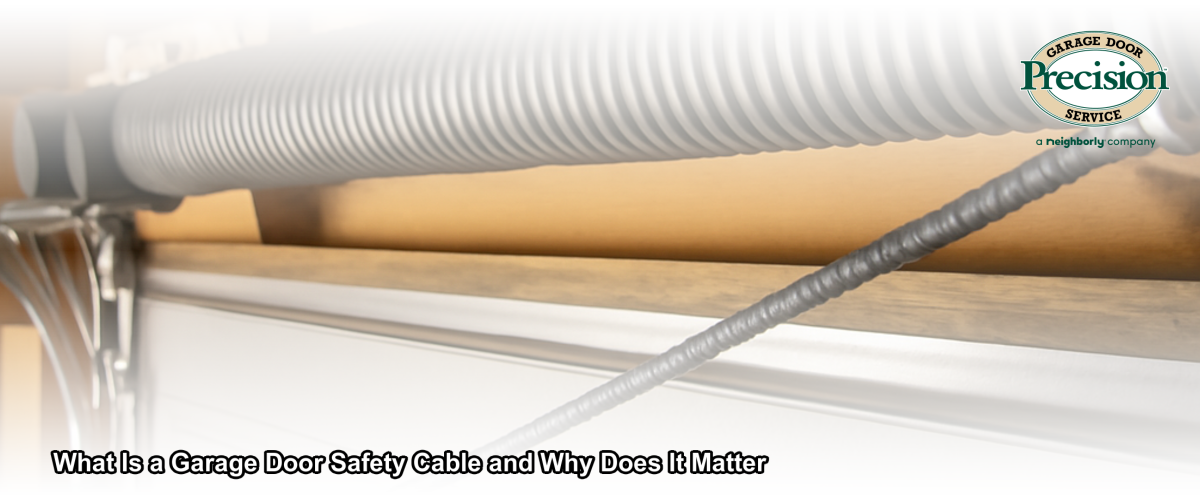
What is a garage door safety cable and what does it do?
A garage door safety cable is a steel wire threaded through the center of each extension spring on your garage door, anchored at both ends so that if the spring snaps, the cable contains the broken pieces and prevents them from flying across the garage at high speed. Without a safety cable in place, a failed extension spring can become a dangerous projectile capable of causing serious injury or property damage in seconds.
Safety cables are a standard, non-negotiable component on any properly installed extension-spring system. If your garage door uses torsion springs — the horizontal bar mounted directly above the door — safety cables work differently there, but the principle of containing spring failure is the same. Understanding which spring system you have is the first step toward knowing what safety hardware protects your household.
Are garage door safety cables required, or are they optional?
Safety cables on extension spring systems are not optional — they are required by the International Door Association (IDA) installation standards and strongly recommended by the Consumer Product Safety Commission. Precision Garage Door Chicago installs safety cables on every extension-spring door as a baseline, not an upgrade, because a garage door without them on an extension-spring system is simply not up to current safety standards.
Homeowners who purchased older homes or had a garage door installed before these standards were widely enforced may find their system is missing cables entirely. If you are unsure whether your door has them, look for thin steel cables running parallel to and through the center of the springs on each side of the door — if you do not see them, schedule an inspection with an IDA Certified Technician as soon as possible.
What happens when a garage door spring breaks without a safety cable?
When an extension spring breaks without a safety cable, the two halves of the spring release their stored tension instantly and can be propelled outward with enough force to shatter a car window, puncture drywall, or injure anyone standing nearby. This is not a theoretical risk — it is one of the most documented causes of garage door-related injury in residential settings.
Chicago winters are particularly hard on garage door springs. Repeated freeze-thaw cycles, temperature swings from below zero to the 40s within a single week, and the humidity that comes off Lake Michigan all accelerate metal fatigue. A spring that looks intact in October can fail suddenly in February. That environmental stress makes having functioning safety cables in Chicago homes more critical than in milder climates — a point Precision Garage Door Chicago’s IDA Certified Technicians flag consistently during seasonal maintenance visits.
How do I know if my garage door safety cables are worn or need replacing?
Signs that a safety cable needs attention include visible fraying of the steel wire, kinks or bends that did not fully straighten out, rust or corrosion along the cable length, or cables that appear slack and are no longer taut along the spring. Any of these conditions means the cable may not perform its containment function when a spring actually fails.
During a standard tune-up or inspection, Precision Garage Door Chicago’s technicians check cable condition alongside spring wear, drum alignment, and hardware torque — because these components work as a system, not in isolation. If a spring is showing signs of fatigue, replacing the cable at the same time is standard practice, since the two parts are under the same stress cycle and typically wear at a similar rate. As covered in our full guide to garage door spring replacement, addressing worn springs and cables together avoids a second service call within months.
Can I inspect or replace garage door safety cables myself?
Visual inspection of safety cables — looking for fraying, rust, or slack — is something a homeowner can do safely from a few feet away without touching the components. Actual replacement of safety cables, however, should always be done by a trained technician, because the springs they thread through are under extreme tension even when the door is in the down position.
Attempting to remove or rethread a cable on a loaded extension spring without the proper tools and training is one of the most common causes of DIY garage door injuries. IDA Certified Technicians use specialized winding bars, locking pliers, and release sequences that are not intuitive without hands-on training. The labor cost of a professional cable replacement is a fraction of an emergency room visit — or the cost of replacing a vehicle damaged by a snapped spring.
What else should I expect during a safety cable service call — and what is included?
When Precision Garage Door Chicago sends an IDA Certified Technician to inspect or replace safety cables, the visit typically covers more than the cables alone. Technicians assess the full spring system, check cable drum condition, verify that the cable anchor brackets are secured to the track properly, and test door balance before and after any work is done.
If a cable replacement is needed on one side, technicians will almost always recommend replacing both sides at the same time — not to upsell, but because mismatched cable wear creates uneven door travel that accelerates wear on rollers, hinges, and the opener itself. Homeowners in Chicago should also know that cold-weather service calls may include a brief door balance re-check after the hardware reaches operating temperature, since metal contracts in extreme cold and tension readings can shift slightly. See our maintenance guide for a full breakdown of what a seasonal tune-up covers and how often Chicago homeowners should schedule one.
How long do garage door safety cables typically last?
Garage door safety cables on a well-maintained system typically last 7 to 12 years, though Chicago’s climate — with its extreme seasonal temperature swings and road-salt humidity — can shorten that range closer to 5 to 8 years for doors that see heavy daily use. Springs on the same system usually cycle out in the 7,000 to 10,000 open-close range, which on a busy household door works out to roughly 7 to 10 years, making it practical to replace cables and springs together.
Precision Garage Door Chicago serves homeowners throughout Chicago, IL and the surrounding area, and our IDA Certified Technicians see firsthand how the region’s winters compress the lifespan of spring hardware. Scheduling an annual inspection — especially heading into fall before the first hard freeze — is the most reliable way to catch cable wear before it becomes an emergency.
This guide was prepared by Precision Garage Door Chicago’s IDA Certified Technicians, serving Chicago, IL and the greater Chicagoland area.
Frequently Asked Questions
What is the purpose of a garage door safety cable?
A garage door safety cable is a steel wire threaded through each extension spring that contains the broken pieces if a spring snaps, preventing them from becoming high-speed projectiles that can injure people or damage property in the garage.
Do all garage doors need safety cables?
Extension-spring garage doors are required to have safety cables under IDA installation standards. Torsion-spring systems use a different containment design. If your extension-spring door is missing safety cables, it is not up to current safety standards and should be serviced promptly.
Can a broken garage door safety cable cause the door to fall?
A broken or missing safety cable does not directly cause the door to fall, but when the spring it protects fails, the uncontrolled release of tension can damage other hardware — including the cable drum and brackets — in a way that leads to an unbalanced or stuck door. The immediate risk is the broken spring becoming a projectile.
How much does it cost to replace garage door safety cables in Chicago?
Safety cable replacement cost varies depending on whether cables alone are replaced or whether spring replacement is included at the same time. Contact Precision Garage Door Chicago directly for current pricing, as technicians assess the full system condition before quoting.
How often should garage door safety cables be inspected in Chicago?
Chicago homeowners should have safety cables and the full spring system inspected at least once a year, ideally before winter. The city’s freeze-thaw cycles and humidity accelerate metal fatigue, making annual inspections by an IDA Certified Technician the most reliable way to catch wear before a spring or cable fails.