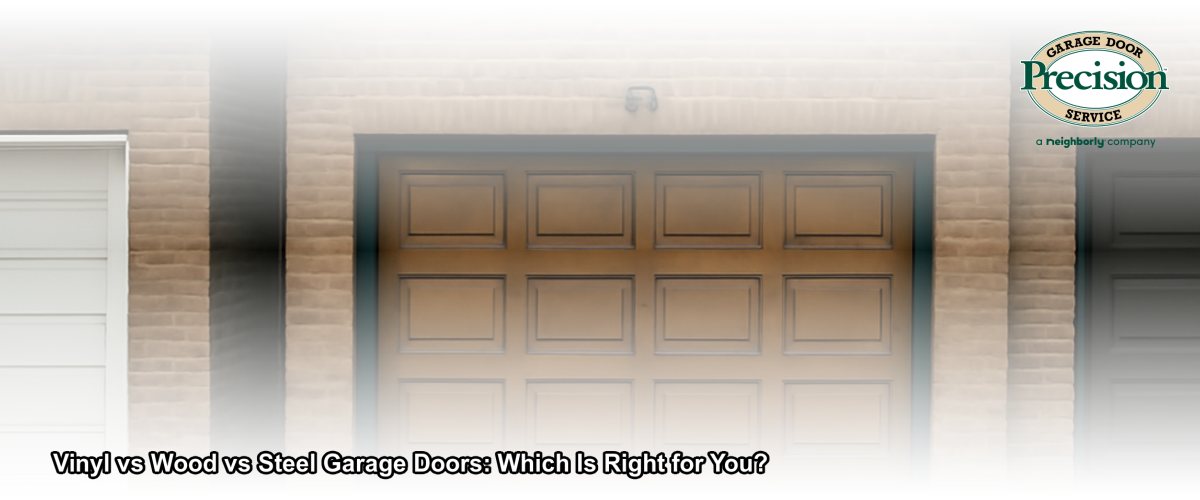
What are the main differences between vinyl, wood, and steel garage doors?
Vinyl, wood, and steel garage doors differ primarily in durability, maintenance requirements, insulation performance, and upfront cost — and in Chicago’s climate, those differences matter more than they would in a mild-weather city. Steel is the most popular choice for Chicago homeowners because it handles freeze-thaw cycles well and comes in insulated versions. Wood offers unmatched curb appeal but demands ongoing upkeep in the face of Chicago’s humid summers and brutal winters. Vinyl sits in between: it won’t rust or rot, but it offers fewer style options and can become brittle in extreme cold.
At Precision Garage Door Chicago, our IDA Certified Technicians install and service all three materials across the city and surrounding suburbs, so the guidance below reflects what we actually see in the field — not just manufacturer brochures.
What are the pros and cons of steel garage doors in Chicago?
Steel garage doors are the most practical choice for most Chicago homeowners because they are strong, low-maintenance, and available with insulation values high enough to meaningfully reduce energy loss through an attached garage.
- Pros: Dent-resistant (thicker gauges), holds paint well, wide style range, easily insulated to R-16 or higher, lowest long-term maintenance cost of the three materials.
- Cons: Can rust if the finish is scratched and left untreated — a real concern given Chicago’s road salt and humidity. Lower-gauge (thinner) steel dents more easily from impact.
Entry-level steel doors typically start around $700–$1,200 installed for a standard single-car door in the Chicago area. Premium insulated steel doors with carriage-house styling can run $1,800–$3,500 or more depending on size and finish. Because steel is so customizable, it is also the easiest material to match to Chicago’s diverse architectural styles — from Lincoln Square two-flats to North Shore colonials.
For a deeper look at insulation options specifically, see our full guide to garage door R-values and energy efficiency for Chicago homes.
What are the pros and cons of wood garage doors in Chicago?
Wood garage doors deliver the richest, most authentic curb appeal of any material, but they require more maintenance in Chicago’s climate than steel or vinyl — expect to refinish or repaint every 2–4 years to prevent warping, cracking, and rot caused by the city’s humidity swings and freeze-thaw cycles.
- Pros: Unmatched aesthetic warmth and grain detail, highly customizable, can be refinished rather than replaced when surface wear sets in, adds perceived home value in high-curb-appeal neighborhoods.
- Cons: Heaviest of the three materials (puts more wear on springs and hardware), most maintenance-intensive, least moisture-resistant, typically the highest upfront cost.
Solid wood doors in the Chicago market generally range from $1,500–$4,500 installed for a single-car door, depending on species (cedar and redwood command a premium over hemlock or pine) and custom millwork. Wood composite doors — which use an engineered wood core clad in a real wood overlay — offer better moisture resistance and start closer to $1,200–$2,500, making them a practical middle ground for homeowners who want the look without full solid-wood maintenance demands.
If your home is in a historic Chicago neighborhood with specific material requirements, always check local landmark or HOA guidelines before selecting a door material — our team can advise on compliant options during a consultation.
What are the pros and cons of vinyl garage doors in Chicago?
Vinyl garage doors are rust-proof, dent-resistant, and require almost no maintenance, making them a solid option for Chicago homeowners who want a low-fuss door — but their style selection is narrower than steel, and they can become brittle during the sub-zero temperatures Chicago regularly sees in January and February.
- Pros: Will not rust or rot, holds color without repainting, resists denting better than thin-gauge steel, good for coastal or high-humidity environments (and Chicago’s lakefront properties).
- Cons: Limited color and style options compared to steel, can crack under hard impact in very cold weather, typically cannot be repainted if you want a color change, insulation options are more limited than steel.
Vinyl doors for a single-car opening in Chicago typically run $900–$1,800 installed. They are a particularly sensible choice for garages near Lake Michigan where salt-air exposure and moisture levels are consistently higher than in inland neighborhoods — rust is simply not a factor with vinyl.
Which garage door material is best for Chicago winters?
For Chicago winters specifically, insulated steel is the best all-around choice because it combines high R-value insulation, structural resistance to freeze-thaw movement, and a finish that — when maintained — holds up against road salt and moisture better than untreated wood.
Chicago averages more than 35 days per year below freezing, and attached garages without proper insulation can lose significant heat through the door panel itself. An insulated steel door rated at R-12 to R-18 can make a measurable difference in both comfort and heating costs for a home with a living space above or adjacent to the garage. Wood doors can be ordered with polystyrene insulation cores, but their tendency to swell and contract with humidity changes can affect seal quality over time. Vinyl insulation options are more limited and harder to achieve at the same R-values as steel.
Whatever material you choose, proper weatherstripping and bottom seals are non-negotiable in Chicago — see our maintenance guide on garage door seals and bottom weatherstripping for details on what to inspect each fall.
How much does it cost to replace a garage door in Chicago, and what affects the price?
In Chicago, the total installed cost for a new garage door ranges from roughly $700 for a basic steel single-car door to $5,000 or more for a custom wood double-car door — with most homeowners landing somewhere between $1,200 and $2,800 depending on material, insulation level, and style.
Key factors that move the price up or down:
- Door width and height: Standard 9×7 single-car and 16×7 double-car openings cost less than non-standard sizes, which require custom manufacturing.
- Insulation level: Adding a factory-insulated panel (polyurethane vs. polystyrene) typically adds $150–$400 to the door cost but pays back in energy savings.
- Hardware and opener: A new door installation often prompts an opener upgrade or new spring installation — budget an additional $200–$600 if those components are due for replacement.
- Removal and disposal of the old door: Most professional installers in Chicago include haul-away in their quoted price — confirm this before signing.
- Permit requirements: Chicago and many suburbs require a permit for full door replacement. Precision Garage Door Chicago handles permit logistics as part of the installation process.
Should I repair my existing garage door or replace it with a new one?
If your existing door is structurally sound but has cosmetic wear, a repair or panel replacement is usually the more cost-effective path — but if the door is more than 15–20 years old, shows significant warping (wood), rust through the skin (steel), or cracking (vinyl), a full replacement typically delivers better long-term value than continued repairs.
Our IDA Certified Technicians at Precision Garage Door Chicago assess door condition as part of every service call and will give you a straight answer on whether repair or replacement makes more financial sense for your specific door and budget. We never recommend replacement when a repair will genuinely solve the problem.
How do I maintain a garage door in Chicago to make it last longer?
Annual maintenance is the single most effective way to extend the life of any garage door material in Chicago — the combination of road salt, humidity, and temperature extremes accelerates wear on hardware, finishes, and seals faster than in most U.S. cities.
Material-specific maintenance priorities:
- Steel: Rinse the door with fresh water each spring to remove road salt residue. Touch up any paint chips or scratches promptly to prevent rust from forming beneath the surface. Lubricate hinges, rollers, and springs twice a year.
- Wood: Inspect the finish each fall before winter sets in. Refinish or repaint every 2–4 years — more frequently on south- and west-facing doors that receive direct sun. Check bottom seal contact across the full width of the door each season.
- Vinyl: Wash with mild soap and water annually. Inspect for cracks, especially at corners, after any extended period of sub-zero temperatures. Lubricate moving hardware the same as you would for steel.
Precision Garage Door Chicago offers annual tune-up service that covers lubrication, balance testing, hardware inspection, and seal assessment — a practical way to catch small problems before Chicago weather turns them into expensive repairs.
This guide was prepared by Precision Garage Door Chicago’s IDA Certified Technicians, serving Chicago, IL and the surrounding region.
Frequently Asked Questions
Which garage door material lasts the longest in Chicago’s climate?
Insulated steel typically lasts the longest in Chicago because it resists rust (when properly maintained), handles freeze-thaw cycles without warping, and requires less upkeep than wood. Vinyl is also highly durable but can crack in extreme sub-zero cold. Wood can last decades with diligent refinishing every 2–4 years, but is the most labor-intensive to maintain.
Is vinyl or steel better for a garage door near Lake Michigan?
Vinyl has a clear edge in lakefront locations because it cannot rust — a significant advantage in the higher moisture and salt-air conditions near Lake Michigan. Steel is still a viable choice if the finish is kept intact and touched up promptly when scratched, but vinyl eliminates that maintenance concern entirely.
How much does a new garage door cost installed in Chicago?
Most Chicago homeowners pay between $1,200 and $2,800 for a professionally installed garage door, though prices range from about $700 for a basic steel single-car door to $5,000 or more for a custom wood double-car door. Insulation level, size, and material are the biggest price drivers.
Do wood garage doors warp in Chicago winters?
Yes, solid wood garage doors can warp, swell, or crack in Chicago’s climate if they are not properly sealed and maintained. Keeping the finish intact with regular refinishing every 2–4 years significantly reduces this risk. Wood composite doors — which use an engineered core — are more moisture-stable than solid wood and are worth considering as an alternative.
What R-value should a garage door have in Chicago?
For an attached garage in Chicago, an insulated door rated at R-12 to R-18 is generally recommended. Chicago averages more than 35 days per year below freezing, and a properly insulated door can reduce heat loss through the panel itself — particularly valuable if there is living space above or adjacent to the garage.