What is the difference between a torsion spring and an extension spring on a garage door?
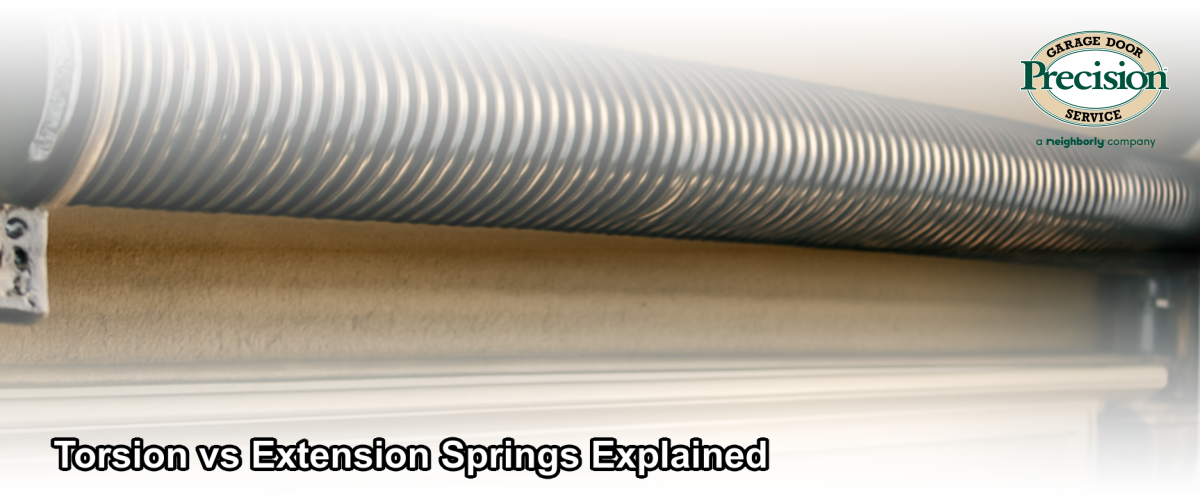
A torsion spring mounts horizontally above the garage door opening and lifts the door by winding and unwinding torque stored in the coil, while an extension spring runs along the horizontal tracks on each side of the door and lifts by stretching and contracting. These are the two fundamentally different mechanical systems used to counterbalance a garage door’s weight — and choosing or identifying the right one matters for safety, longevity, and cost.
At Precision Garage Door Chicago, our IDA Certified Technicians work on both systems throughout the Chicago metro area, and the question of which spring type a customer has — or should have — comes up on nearly every service call.
How do torsion springs and extension springs actually work?
Torsion springs store mechanical energy by twisting around a steel shaft mounted directly above the door header. When the door closes, the spring winds tighter; when you open the door, that stored tension unwinds and does the heavy lifting. A standard single-car door uses one torsion spring, while heavier double-car doors typically use two.
Extension springs work on a stretch-and-recoil principle. They attach to a cable-and-pulley system along the horizontal track on each side and extend outward as the door closes, then snap back to pull the door open. Because they fully extend under tension, they require safety cables threaded through the coil to contain the spring if it breaks — a critical detail covered more fully in our guide to garage door safety cables.
Which spring type lasts longer — torsion or extension?
Torsion springs typically last 15,000 to 20,000 cycles, while standard extension springs are rated for 10,000 cycles — meaning a torsion spring can outlast an extension spring by 5 to 10 years under average residential use. One cycle equals one complete open-and-close sequence; a household that operates the garage door 4 times per day goes through roughly 1,460 cycles per year.
Chicago’s climate adds real stress to both spring types. Extreme cold — including the sub-zero wind chills that hit neighborhoods from Ravenswood to Beverly during January and February — causes steel to contract and become more brittle, accelerating metal fatigue. Torsion springs handle this thermal cycling better because the coil is more compact and shielded directly above the door rather than stretched along an exposed track.
Which spring type is safer?
Torsion springs are generally considered the safer design because a broken torsion spring stays on the shaft above the door rather than launching across the garage. A snapped extension spring, by contrast, can recoil violently if a safety cable is not installed — releasing stored energy equivalent to a serious projectile hazard.
The International Door Association (IDA), whose certification standards Precision Garage Door Chicago’s technicians are trained to, recommends that any extension spring installation include properly fitted safety cables. If your extension springs are missing these cables, that is a repair worth scheduling before the spring fails on its own.
How much does it cost to replace a torsion spring vs. an extension spring in Chicago?
In the Chicago area, professional torsion spring replacement typically ranges from $150 to $350 for a single spring, and $250 to $500 for a double-spring setup on a heavier door. Extension spring replacement generally runs $100 to $250 per pair, making them less expensive upfront — but that lower cost reflects their shorter rated lifespan.
What hidden costs should I expect with spring replacement?
Beyond the spring itself, be aware of the following common add-ons that affect the final price:
- Safety cables — often $25 to $50 extra if not already installed alongside extension springs
- Cable drum or end bearing replacement — worn hardware discovered during a torsion spring job can add $40 to $100
- Spring upgrade to a higher cycle rating — stepping up to a 25,000-cycle commercial-grade torsion spring adds cost upfront but reduces future service calls
- After-hours or emergency service — a spring that snaps on a Sunday morning in Chicago is still an emergency call, and weekend or late-evening rates typically carry a premium
At Precision Garage Door Chicago, pricing is quoted before any work begins, so there are no surprise charges on the invoice.
Can I replace a garage door spring myself in Chicago?
Garage door spring replacement is one of the few home repairs that IDA Certified Technicians actively caution homeowners against attempting themselves, and for good reason. Torsion springs are wound under hundreds of pounds of torque; releasing or winding that tension incorrectly with improvised tools has caused serious injuries. Extension springs under tension are similarly dangerous if the cable system is not properly managed during removal.
Illinois does not require a license for garage door repair, but that means the barrier to entry for uncertified companies is also low — another reason to verify IDA certification before any technician touches your springs. If you are comparing DIY spring kits found online against a professional quote, factor in the specialized winding bars, torque precision, and liability that a trained technician brings to the job.
Which spring type is right for my Chicago home?
Most Chicago homes built after the mid-1990s already use torsion springs, which became the industry standard as garage door weights increased with larger double-car doors and heavier insulated panels. If your home has an older single-car door with a low headroom clearance — common in bungalows and two-flats across neighborhoods like Pilsen, Logan Square, and Bridgeport — extension springs may be the correct fit because they require less vertical space above the door opening.
The best way to confirm which system is right for your specific door, weight, and headroom is a professional assessment. Precision Garage Door Chicago serves the full Chicago metro area, and our IDA Certified Technicians can evaluate your current setup and recommend whether to replace in kind or upgrade to a torsion system if the header clearance allows it.
Should I replace both springs at the same time?
Yes — when one spring breaks, replacing both at the same time is the standard professional recommendation, and for good reason. If your door uses two torsion springs or a pair of extension springs, both were installed at the same time and have accumulated the same number of cycles. The second spring is statistically likely to fail within weeks or months of the first.
Replacing both during a single service visit also saves on a second labor charge and keeps the door balanced. An unbalanced door — where one spring is new and one is worn — puts uneven stress on the opener motor, cables, and rollers, shortening the life of those components as well. See our full guide to garage door maintenance for a complete look at how springs interact with the rest of your door system.
This guide was prepared by Precision Garage Door Chicago’s IDA Certified Technicians, serving Chicago, IL and the surrounding metro area.
Frequently Asked Questions
What is the main difference between a torsion spring and an extension spring?
A torsion spring mounts above the garage door opening and lifts by winding stored torque around a steel shaft. An extension spring runs along the side tracks and lifts by stretching and recoiling. Torsion springs last longer — typically 15,000 to 20,000 cycles versus 10,000 for extension springs — and are generally considered the safer design.
How much does garage door spring replacement cost in Chicago?
In Chicago, professional torsion spring replacement runs roughly $150 to $350 for a single spring or $250 to $500 for a two-spring system. Extension spring replacement is typically $100 to $250 per pair. Final cost can increase if safety cables, cable drums, or worn hardware also need replacement.
Is it safe to replace a garage door spring myself?
Spring replacement is not recommended as a DIY project. Torsion springs are wound under hundreds of pounds of torque, and releasing that tension without the right tools and training has caused serious injuries. IDA Certified Technicians have the specialized equipment and training to do the job safely.
How long do garage door springs last in Chicago’s climate?
Chicago’s cold winters accelerate metal fatigue in both spring types. Under average use of about 4 cycles per day, torsion springs typically last 10 to 15 years and extension springs 7 to 10 years. Extreme cold snaps common in Chicago winters can shorten those timelines by stressing the steel.
Should I replace both garage door springs at the same time?
Yes. Both springs age at the same rate, so when one fails the other is near the end of its life as well. Replacing both in one visit saves on a second service charge and keeps the door balanced, which protects the opener, cables, and rollers from added wear.