What are garage door rollers and what do they actually do?
Garage door rollers are the small wheel-and-stem components that sit inside the vertical and curved tracks on either side of your door, allowing it to glide smoothly up and down every time you open or close it. A standard residential garage door uses 10 to 12 rollers, and when even one wears out, you may notice shaking, grinding, or a door that feels heavier than it used to.
Most homeowners never think about rollers until something goes wrong — but the type of roller installed on your door quietly determines how loud, how smooth, and how long-lasting your daily operation will be. Precision Garage Door Chicago replaces rollers as one of the most common single-component repairs across the Chicago metro area.
What is the difference between steel and nylon garage door rollers?
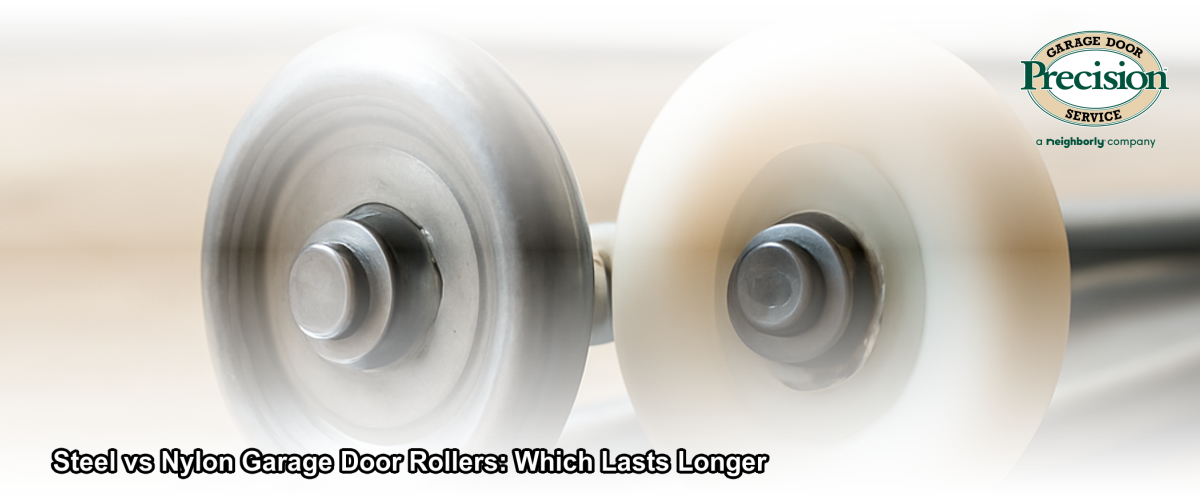
Steel rollers have a metal wheel that rides directly on the track, while nylon rollers use a reinforced plastic composite wheel — usually over a steel stem and ball-bearing core — that cushions the contact between the wheel and the track surface.
The practical differences show up in three areas:
- Noise: Nylon rollers run significantly quieter because the composite material absorbs vibration rather than transmitting it through the metal track and door frame.
- Lubrication: Steel rollers require regular lubrication to prevent corrosion and grinding. Nylon rollers with sealed bearings are largely maintenance-free between replacements.
- Cost: Steel rollers cost less upfront — typically $5 to $10 per roller — while nylon rollers run $10 to $20 per roller depending on bearing count and diameter.
Which type of roller lasts longer — steel or nylon?
Nylon rollers with sealed ball bearings generally outlast basic steel rollers by a significant margin, with a typical service life of 10,000 to 20,000 cycles compared to 5,000 to 10,000 cycles for standard steel rollers without bearings.
One cycle equals one complete open-and-close operation. A household that opens and closes its garage door 4 times per day will hit 10,000 cycles in roughly 7 years. That means a basic steel roller could need replacement twice in the same window that a quality nylon roller serves without issue. Higher-end nylon rollers rated at 20,000 cycles can realistically last 14 years or more under the same usage pattern.
It is worth noting that steel rollers with precision ball bearings — sometimes called heavy-duty steel rollers — close the gap considerably. These can match or exceed the lifespan of entry-level nylon rollers, making bearing count a more reliable performance indicator than material alone.
How does Chicago’s climate affect garage door roller lifespan?
Chicago winters put unique stress on garage door hardware that homeowners in milder climates simply do not face. Temperature swings from below 0°F in January to above 90°F in July cause metal tracks to contract and expand, which affects how precisely the roller seats in the track — and how quickly unlubricated steel rollers begin to wear.
Moisture is the other major factor. Salt air, road runoff, and freeze-thaw cycles accelerate rust formation on exposed steel components. Steel rollers without corrosion-resistant coatings can show visible rust within a single Chicago winter if lubrication has lapsed. Nylon rollers are inherently rust-proof, which is a meaningful advantage in this climate — the wheel itself will never corrode, even if the steel stem does over many years.
Precision Garage Door Chicago’s IDA Certified Technicians factor in local climate conditions when recommending roller type and lubricant during every service call, particularly for attached garages that are not temperature-controlled.
What does roller replacement actually cost in Chicago, and what is included?
A professional roller replacement service in Chicago typically runs $100 to $200 for a full set, covering labor and parts for all 10 to 12 rollers on a standard single-car door. Replacing only the visibly worn rollers rather than the full set is possible but rarely recommended — rollers on the same door age at similar rates, and a partial replacement usually means a return visit within a year or two.
What a quality roller replacement appointment should include:
- Removal and disposal of worn rollers
- Inspection of tracks for dents, misalignment, or debris that would accelerate wear on new rollers
- Installation of new rollers with proper stem length for your specific door and track gauge
- Lubrication of the full hardware set — hinges, springs, and tracks — not just the new rollers
- Balance and travel test to confirm smooth operation before the technician leaves
Hidden costs to be aware of: if the track inspection reveals bent or corroded sections, track repair or replacement is a separate line item. Similarly, if a hinge that holds the roller bracket is cracked, replacing the roller without addressing the hinge defeats the purpose. Our technicians will identify these issues during the visit and quote any additional work before proceeding — never after.
Are nylon rollers worth the extra cost for a Chicago home?
For most Chicago homeowners, nylon rollers with 13-ball sealed bearings are worth the premium because the combination of longer lifespan, lower maintenance, and quieter operation produces a lower total cost of ownership over a 10-year window — even accounting for the higher upfront price per roller.
The case for nylon is especially strong in attached garages where bedrooms or living spaces share a wall with the garage. A steel roller on an unlubricated track can register as a grinding or rattling sound that carries clearly into adjacent rooms. Nylon rollers on a properly aligned track are nearly silent — a difference homeowners notice immediately after a swap.
Steel rollers remain a legitimate choice when budget is the primary constraint, when the door is a detached garage with no noise-sensitivity concerns, or when a heavy-duty commercial-style door requires the added load capacity of a precision steel roller. As covered in our full garage door maintenance guide, the right roller choice also depends on your spring type and door weight — factors an IDA Certified Technician can assess on-site.
How do I know when my garage door rollers need to be replaced?
Rollers typically signal wear through noise, movement, or visible damage — any one of the following signs warrants a prompt inspection by a professional rather than waiting for a complete failure.
- Grinding or squealing when the door moves, especially during cold weather
- Visible cracks, chips, or flat spots on the roller wheel
- Wobbling or shaking along the door’s travel path
- Rust or corrosion on the roller wheel or stem
- The door feels heavier or the opener strains noticeably more than usual
- The door jumps off track — this is often caused by a failed roller, not the track itself
A door that repeatedly comes off track is a safety issue, not just a convenience problem. Garage door panels and springs under tension can cause injury if the door shifts unexpectedly. Precision Garage Door Chicago strongly recommends calling an IDA Certified Technician immediately if your door leaves its track rather than attempting to reset it manually.
Can I replace garage door rollers myself, or should I hire a professional?
Replacing the middle and top rollers on a garage door is a manageable DIY task for a mechanically confident homeowner — but the bottom rollers, which are attached to the bottom bracket connected to the lift cables, should only be replaced by a trained technician.
The bottom bracket sits under extreme cable tension from the torsion or extension springs. Releasing that tension incorrectly can cause the cable to snap or the door to drop suddenly, both of which represent serious injury risks. IDA Certified Technicians carry the proper winding tools and training to handle spring-adjacent work safely.
For the remaining rollers, the DIY process involves loosening the hinge bolts, sliding the old roller stem out of the hinge bracket, seating the new roller, and retightening — straightforward in principle, but time-consuming on a 10-roller door and easy to misalign if stem diameter or length does not match the existing hardware. Precision Garage Door Chicago stocks rollers in the correct specifications for most Chicago-area door models, which eliminates the guesswork of sourcing parts independently.
This guide was prepared by Precision Garage Door Chicago’s IDA Certified Technicians, serving Chicago, IL and the surrounding metro area.
Frequently Asked Questions
How long do garage door rollers last?
Standard steel rollers typically last 5,000 to 10,000 cycles, while nylon rollers with sealed ball bearings can reach 10,000 to 20,000 cycles. For a household opening and closing the garage door 4 times a day, that translates to roughly 7 to 14 years of service life depending on roller type and maintenance.
Are nylon garage door rollers better than steel?
Nylon rollers with sealed bearings are quieter, rust-proof, and longer-lasting than basic steel rollers, making them the better choice for most residential applications — especially in climates like Chicago where freeze-thaw cycles and road salt accelerate steel corrosion. Steel rollers with precision ball bearings are a competitive alternative for heavier doors or budget-focused replacements.
How much does it cost to replace garage door rollers in Chicago?
A full roller replacement in Chicago typically costs between $100 and $200, covering labor and a complete set of 10 to 12 rollers. The part cost alone ranges from $5 to $10 per steel roller and $10 to $20 per nylon roller, with additional charges if track damage or worn hinges are discovered during the inspection.
Can I replace garage door rollers myself?
Middle and upper rollers can be replaced by a confident DIYer, but the bottom rollers — attached to the cable bracket under spring tension — must be handled by a trained professional. Attempting to release that tension without proper tools and training risks cable snapping or sudden door drop, both of which can cause serious injury.
Why are my garage door rollers so loud in winter?
Cold temperatures cause metal tracks to contract, tightening the fit around the roller wheel and amplifying grinding or squealing sounds — especially if lubrication has dried out or the rollers are already worn. Chicago winters are particularly hard on uncoated steel rollers; a lubrication service or upgrade to sealed nylon rollers typically resolves winter noise issues.