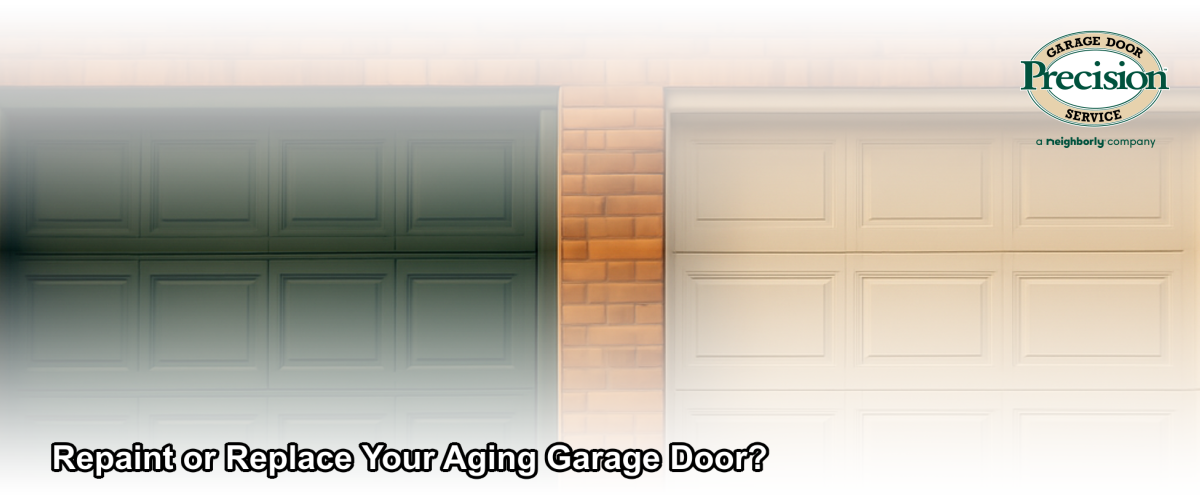
How do you know whether to repaint or replace an aging garage door?
If your garage door still operates smoothly, holds its structure, and shows only surface-level fading or peeling, repainting is a cost-effective fix. If the panels are warped, cracked, rotting, or the door is showing signs of structural failure — especially after years of Chicago freeze-thaw cycles — replacement is almost always the smarter long-term investment.
The distinction matters because painting over a structurally compromised door is cosmetic at best and misleading at worst. A fresh coat of paint will not stop a warped panel from letting in drafts, and it will not restore a door whose seals, springs, or bottom weatherstripping have failed. At Precision Garage Door Chicago, our IDA Certified Technicians assess both the cosmetic and mechanical condition before recommending a path forward.
What does it cost to repaint a garage door in Chicago?
Professional garage door repainting in the Chicago area typically runs $200–$500 for a standard single-car door and $350–$750 for a double-car door, depending on door material, prep work required, and paint product chosen.
Those figures assume the door is in paintable condition. If significant scraping, sanding, or spot priming is needed — common on wood doors that have gone several winters without maintenance — prep labor can add $75–$150 to the job. High-quality exterior paint rated for temperature extremes (essential in Chicago, where temperatures routinely swing from -10°F in January to 90°F in July) costs more per gallon than standard exterior latex but is not optional if you want the finish to last more than one or two seasons.
What does it cost to replace a garage door in Chicago?
A new garage door installation in Chicago typically ranges from $700–$1,500 for a standard steel single door to $1,200–$3,500+ for a double door, with premium materials like carriage-house wood, fiberglass, or full-view aluminum pushing costs higher.
That range includes removal of the old door and professional installation by certified technicians — it does not include opener replacement or new hardware if those components also need updating. As covered in our full guide to garage door replacement costs, the final number depends heavily on insulation rating (R-value), panel style, and whether the existing tracks and springs can be reused. For Chicago homeowners, investing in an insulated door with a minimum R-12 rating is strongly recommended to offset heating and cooling costs in an attached garage.
What are the signs a garage door is too far gone to repaint?
Seven clear signals that repainting will not solve your problem:
- Panels are visibly warped, bowed, or delaminating
- Wood rot has penetrated beyond the surface layer
- Rust has eaten through the metal rather than sitting on the surface
- The door no longer seals evenly at the bottom or sides, causing drafts
- Sections are dented deeply enough to affect how the door tracks
- The door is uninsulated and more than 15–20 years old
- Repeated repainting over the years has built up thick, peeling layers that cannot be sanded back to a clean substrate
In Chicago’s climate, wood doors are especially vulnerable. The lakefront humidity, road salt carried inland from Lake Shore Drive during winter, and hard freeze-thaw cycles accelerate deterioration faster than in drier Midwestern cities. If a wood door has not been painted or sealed within the last 3–4 years, deep moisture damage is a real possibility worth inspecting before committing to another paint job.
How long does a repaint actually last on a Chicago garage door?
A professionally applied exterior repaint on a garage door in good structural condition typically lasts 5–7 years in the Chicago climate when high-quality, temperature-rated paint is used — closer to 3–4 years if a budget product is applied or if prep work is skipped.
South- and west-facing doors take more direct UV exposure and may need attention sooner. North-facing doors in Chicago tend to hold paint longer on the sun side but suffer more from trapped moisture and slower drying after rain. Regardless of orientation, a light cleaning and inspection every spring — after Chicago’s harshest months — is the single best way to extend the life of any paint job and catch problems before they become structural ones. See our maintenance checklist for a full seasonal walkthrough.
Is DIY repainting a garage door worth it in Chicago?
DIY repainting is feasible for a homeowner with basic prep skills and the right materials, but it is rarely as cost-effective as it looks on paper once you account for primer, quality exterior paint, brushes or a sprayer, tape, drop cloths, and a full day of labor — and Chicago’s weather windows for exterior painting are genuinely narrow.
Exterior paint should not be applied below 50°F or above 90°F, and it needs several hours of dry time without rain. In Chicago, that realistically limits exterior painting to a few weeks in late spring and early fall. If you miss the window, the paint will not cure properly and adhesion will fail within one to two seasons. A professional crew with the right equipment can complete the job in a single day and warranty the work — a meaningful advantage when scheduling around Chicago’s unpredictable spring and fall weather.
What hidden costs should Chicago homeowners watch for when replacing a garage door?
Replacement projects often surface costs that were not part of the original quote, and knowing them in advance prevents budget surprises:
- Spring replacement: If the existing torsion or extension springs are worn, a responsible installer will replace them at the same time — typically $150–$300 added to the job — rather than leave aging springs on a new door.
- Track and bracket repairs: Older Chicago homes with wooden garages sometimes have out-of-square openings or deteriorated framing that requires carpentry before the new door can be hung properly.
- Permit requirements: The City of Chicago may require a permit for full door-and-frame replacements in certain zoning districts or historic neighborhoods. Your contractor should pull the permit; confirm this upfront.
- Opener compatibility: A heavier or taller replacement door may require a higher-horsepower opener than the one currently installed.
- Hauling and disposal: Confirm whether old door removal and disposal is included in the quote or billed separately.
At Precision Garage Door Chicago, our IDA Certified Technicians walk through all of these factors during an on-site assessment so there are no line items added after the fact.
Which garage door materials hold up best to Chicago winters?
Steel and fiberglass doors consistently outperform wood in Chicago’s climate because they do not absorb moisture, do not warp through freeze-thaw cycles, and require far less annual maintenance to keep their finish intact.
Insulated steel doors with a polyurethane or polystyrene core offer the best combination of durability, thermal performance, and long-term finish stability for Chicago conditions. Wood doors remain popular for historic bungalows and vintage two-flats throughout neighborhoods like Logan Square, Pilsen, and Beverly — but they require a genuine maintenance commitment: sealing or repainting every 2–3 years at minimum, not every five to seven. Fiberglass doors can mimic a wood grain appearance while resisting moisture and salt air far better than real wood, making them a strong middle-ground option for homeowners who want the aesthetic without the upkeep.
This guide was prepared by IDA Certified Technicians at Precision Garage Door Chicago, serving Chicago, IL and the surrounding Chicagoland area.
Frequently Asked Questions
Is it cheaper to repaint or replace a garage door in Chicago?
Repainting costs roughly $200–$750 depending on door size and prep needed, while replacement runs $700–$3,500 or more. Repainting is cheaper short-term, but if the door is structurally compromised, replacement saves money over time by eliminating repeated paint jobs and energy loss.
How often does a garage door need to be repainted in Chicago?
In Chicago’s climate, a professionally applied repaint using temperature-rated exterior paint typically lasts 5–7 years on a door in good condition. Budget products or skipped prep work can cut that to 3–4 years. Wood doors in particular should be inspected every 2–3 years given the city’s harsh freeze-thaw cycles.
Can I paint my garage door myself in Chicago?
Yes, but the weather window is limited — exterior paint should not be applied below 50°F or above 90°F and needs hours of rain-free dry time, which restricts Chicago DIY painting to a few weeks in late spring and early fall. Skipping proper prep or painting in marginal conditions typically causes early adhesion failure.
What type of garage door lasts longest in Chicago winters?
Insulated steel doors with a polyurethane core offer the best durability in Chicago’s climate. They resist moisture absorption, do not warp through freeze-thaw cycles, and hold their finish far longer than wood. Fiberglass is a close second, especially for homeowners who want a wood-grain look without the maintenance demands.
When should I stop repainting my garage door and just replace it?
Stop repainting and replace when you see warped or bowed panels, rust that has eaten through the metal, wood rot below the surface, persistent bottom-seal gaps causing drafts, or if the door is uninsulated and more than 15–20 years old. At that point, paint is masking a structural problem rather than solving one.