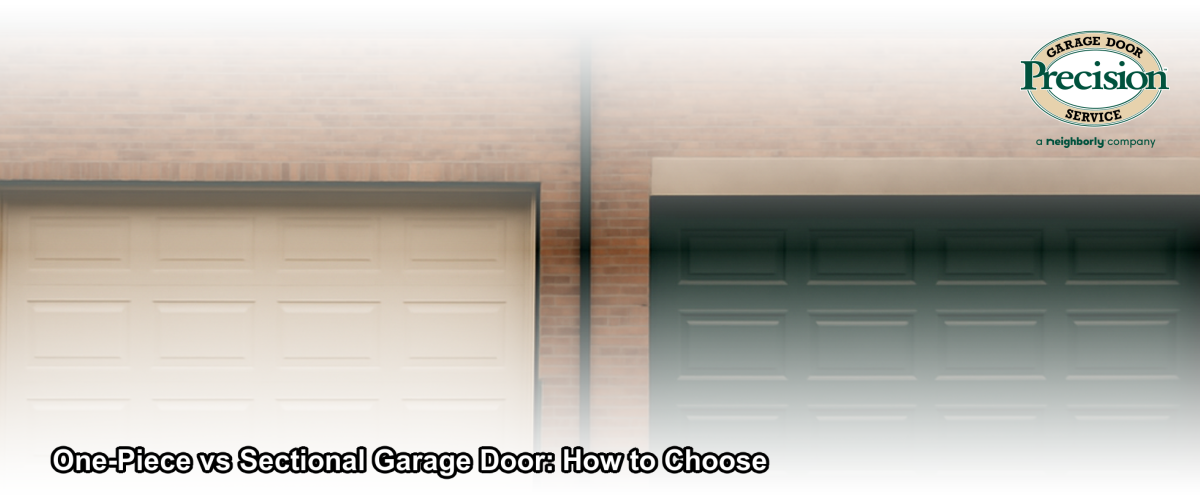
What is the difference between a one-piece and a sectional garage door?
A one-piece garage door is a single solid panel that swings outward at the bottom and tilts up into the garage ceiling as a unit, while a sectional garage door is made of four to six horizontal panels hinged together that roll straight up along vertical and curved tracks without swinging into the driveway. That fundamental difference in movement affects everything — clearance requirements, driveway space, spring systems, and long-term performance in Chicago’s climate.
One-piece doors (also called tilt-up or swing-up doors) were common in mid-century homes and are still found throughout older Chicago neighborhoods. Sectional doors have become the dominant style nationally and are the default recommendation from IDA Certified Technicians at Precision Garage Door Chicago for most residential installations today.
Which garage door type works better for Chicago’s winters?
Sectional garage doors handle Chicago winters significantly better than one-piece doors because their panel joints can be fitted with continuous weatherstripping and their bottom seal sits flush against the garage floor without requiring clearance for an outward swing. Chicago regularly sees temperatures drop well below freezing, and a door that swings outward can be blocked by ice accumulation or snow drifts packed against the base of the door — a problem sectional doors avoid entirely.
Sectional doors are also more compatible with modern insulation cores — typically 2-inch polyurethane or polystyrene fill — which helps maintain usable temperatures in attached garages during Chicago’s coldest months. One-piece doors can be insulated, but the single-panel construction limits how well insulation can be sealed at the edges. If energy efficiency or climate control matters to you, as covered in our full guide to garage door insulation, sectional panels offer a clear advantage for the Chicago area.
How much does each type of garage door cost in Chicago?
In the Chicago market, a professionally installed one-piece garage door typically runs $400 to $900 including hardware, while a standard single-car sectional door with professional installation generally starts between $700 and $1,500 — and can reach $3,000 or more for premium steel, wood composite, or custom carriage-style sectional panels.
The lower upfront cost of a one-piece door can be appealing, but it comes with trade-offs worth factoring in:
- One-piece doors use a simpler spring system (typically a single extension spring or a pair), but replacement parts are increasingly hard to source as this door style has been discontinued by most major manufacturers.
- Sectional doors use torsion or extension spring systems with widely available parts, making future repairs more straightforward and often less expensive per service call.
- Labor costs for repairing a one-piece door can run higher in Chicago precisely because fewer technicians specialize in them — another reason Precision Garage Door Chicago recommends sectional doors for long-term value.
What clearance and driveway space do you need for each type?
A one-piece garage door requires at least 2 to 4 feet of clear driveway space in front of the garage opening because the bottom of the door swings outward as it opens — meaning a car parked close to the door can be struck during operation. Sectional doors open vertically and require zero additional driveway clearance, making them the only practical choice for Chicago homes with short driveways, rear-entry garages, or alley-facing garages common in city neighborhoods.
Overhead clearance is the other dimension to check. Standard sectional doors need roughly 10 to 12 inches of headroom above the door opening for the horizontal tracks. One-piece doors need similar headroom but also require the full interior ceiling depth to accommodate the panel when horizontal. In vintage Chicago two-flats or coach houses with low garage ceilings, a pre-installation measurement by an IDA Certified Technician is essential before selecting either style.
Can a one-piece garage door be automated with an opener?
One-piece garage doors can be motorized, but compatibility with modern garage door openers is limited and often requires an adapter arm kit, because the outward swing arc does not match the straight-pull path a standard opener is designed for. Many newer openers — particularly belt-drive and wall-mount models — are engineered specifically for sectional doors and will not work with a tilt-up configuration at all.
Sectional doors are compatible with every major opener type: chain-drive, belt-drive, screw-drive, and jackshaft (wall-mount) models. If smart-home integration, battery backup, or MyQ-style connectivity is on your list — features that are increasingly standard in new Chicago home construction — a sectional door is the practical choice. Our guide to garage door opener selection covers compatibility in detail for each drive type.
Which door type is easier to repair and maintain over time?
Sectional doors are substantially easier and less expensive to maintain over the long run because individual panels can be replaced if one is dented or damaged, without replacing the entire door. With a one-piece door, significant damage to any part of the panel typically means replacing the whole unit — and sourcing a matching replacement door can be difficult since most manufacturers have phased out one-piece production.
Both types require annual lubrication of moving parts — springs, hinges, and rollers — and periodic inspection of the bottom seal and weatherstripping. In Chicago’s freeze-thaw cycles, the bottom seal on any garage door takes particular abuse and should be inspected each fall. The IDA Certified Technicians at Precision Garage Door Chicago recommend a seasonal tune-up before winter, covering spring tension, balance testing, and hardware inspection for either door style.
Are there situations where a one-piece door is still the right choice?
A one-piece door may still make sense in a limited set of circumstances: a detached garage used purely for storage (not vehicle parking), a budget-constrained repair situation where the existing one-piece hardware is still serviceable, or a historic property where the original door style is part of a preservation requirement. Outside those scenarios, the combination of better weathersealing, opener compatibility, panel repairability, and driveway clearance advantages makes the sectional door the stronger choice for nearly every Chicago homeowner.
If you are replacing an existing one-piece door, the conversion to a sectional system typically requires new tracks, a new spring system, and a header bracket installation — work that should be completed by a certified professional. Precision Garage Door Chicago handles full conversions throughout the Chicago area, and our technicians can assess whether your existing framing and headroom support a direct swap or need modification first.
What hidden costs should Chicago homeowners expect during a door replacement?
Beyond the door panel and basic hardware, a full replacement project in Chicago may involve several additional line items worth budgeting for before you commit to a quote:
- Framing repairs: Older Chicago garages — particularly those built before 1970 — often have deteriorated wood framing around the opening that must be repaired or sistered before new tracks can be mounted safely.
- Spring system upgrade: Converting from a one-piece door to a sectional requires a new torsion or extension spring system. Torsion springs typically cost $150 to $300 in parts alone, plus labor.
- New opener or adapter: If your existing opener is not compatible with the new door type, budget an additional $250 to $600 for a replacement unit installed.
- Weatherstripping and bottom seal: These are wear items that should be replaced at installation on any door over five years old — typically a modest add-on of $30 to $80 in parts.
- Permit requirements: Some Chicago-area municipalities require a permit for garage door replacement when structural framing is altered. Your technician should confirm local requirements before work begins.
Getting an itemized written quote from Precision Garage Door Chicago before any work begins is the best way to avoid unexpected charges — and allows you to compare the true all-in cost of each door type side by side.
This guide was prepared by IDA Certified Technicians at Precision Garage Door Chicago, serving Chicago, IL and the surrounding area.
Frequently Asked Questions
Can I replace a one-piece garage door with a sectional door in Chicago?
Yes, and it is a common upgrade. The conversion requires new tracks, a new spring system, and a header bracket — work that typically takes a professional half a day to a full day depending on whether the existing framing needs repair. Precision Garage Door Chicago’s IDA Certified Technicians handle full one-piece to sectional conversions throughout the Chicago area.
Is a sectional garage door better for Chicago winters?
Sectional doors are better suited to Chicago winters because they seal flush to the ground without an outward swing, can accommodate thick insulation cores, and will not be blocked by snow or ice buildup at the base the way a tilt-up door can. Their continuous weatherstripping along panel joints also reduces cold-air infiltration more effectively.
How much does it cost to replace a one-piece garage door with a sectional in Chicago?
A full replacement — including the new sectional door, spring system, tracks, and professional installation — typically runs between $700 and $1,500 for a standard single-car door in the Chicago market, with premium or custom options reaching $3,000 or more. Additional costs for framing repairs, a new opener, or permit fees can add to that total.
Do one-piece garage doors work with automatic openers?
One-piece tilt-up doors can be motorized, but they require an adapter arm and are incompatible with many modern opener models, including wall-mount and smart-home-connected units. Sectional doors work with all standard opener types and offer full compatibility with smart-home integration features.
How much driveway space does a one-piece garage door need to open safely?
A one-piece door requires at least 2 to 4 feet of clear space in front of the garage opening because the bottom panel swings outward during operation. A sectional door opens vertically and needs no additional driveway clearance, making it the practical choice for short Chicago driveways and alley-access garages.