How do you know when a garage door needs to be fully replaced instead of repaired?
Your garage door needs full replacement — rather than a repair — when the cost of ongoing fixes approaches or exceeds the value of a new door, when structural damage compromises safety, or when the door is so old that compatible parts are no longer available. A single broken spring or snapped cable is almost always a repair. But repeated failures, severe panel damage, or a door that no longer seals against Chicago winters point clearly toward replacement.
At Precision Garage Door Chicago, our IDA Certified Technicians assess every door on this exact question: is this a repair situation or a replacement situation? The answer changes depending on the door’s age, damage type, and how it has been maintained. The sections below walk through each deciding factor.
What does severe panel damage look like, and does it always mean replacement?
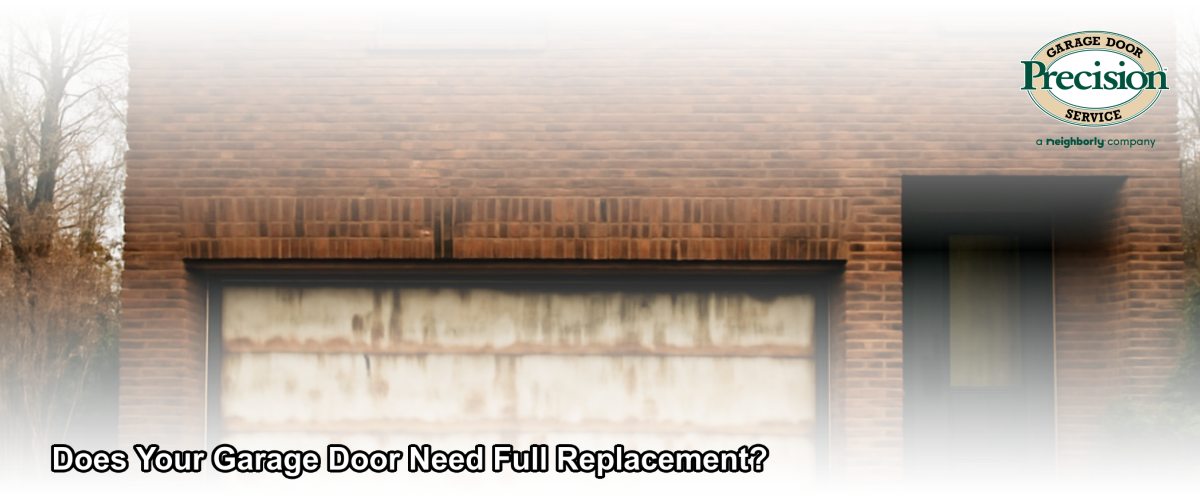
Severely cracked, buckled, or caved-in panels that affect the door’s structural alignment are one of the most reliable signs that replacement is the right call. A single dented section on an otherwise sound door can sometimes be swapped out if the panel style is still manufactured — but when multiple sections are warped or when the bottom panel has taken a hard impact that bent the door’s bottom seal track, the entire door’s integrity is compromised.
Chicago’s freeze-thaw cycle is particularly hard on steel and wood doors. Repeated expansion and contraction can cause panel seams to separate, allowing moisture intrusion that leads to rust from the inside out. If you are seeing rust bleed along panel joints, bubbling paint, or soft spots on a wood door, those are signs of damage that no surface repair will resolve long-term.
Is an aging garage door worth repairing, or is replacement more cost-effective?
A garage door that is 15 to 20 years old or older is generally a strong replacement candidate, even if the current repair needed seems minor, because aging doors tend to require increasingly frequent service calls. Each repair has a cost, and those costs compound quickly on a door that is near the end of its service life.
A practical rule of thumb: if the estimated repair cost exceeds 50% of the price of a comparable new door, replacement delivers better long-term value. New doors also come with updated safety features — including modern auto-reverse sensors and tamper-resistant brackets — that older doors may lack entirely. As our team at Precision Garage Door Chicago often notes, a new door is not just a repair; it is an upgrade to security, insulation, and curb appeal all at once.
What are the hidden costs and what is included in a full garage door replacement?
Understanding what a replacement project actually covers helps you compare quotes accurately and avoid surprises. A full replacement from Precision Garage Door Chicago typically includes removal and disposal of the old door, delivery and installation of the new door and all new hardware, and adjustment of the opener to match the new door’s weight and balance.
Costs that can add to the base price include:
- Upgrading to an insulated door (important for attached garages in Chicago’s climate, where winters regularly drop well below freezing)
- Replacing an outdated opener at the same time — often the most cost-efficient moment to do so
- Repairing or replacing the door frame if rot or damage is found during removal
- Adding weatherstripping or a new bottom seal if the existing threshold is worn
Our IDA Certified Technicians will walk through each of these line items before work begins so there are no after-the-fact additions to your invoice.
How does Chicago’s climate affect how quickly a garage door deteriorates?
Chicago’s climate is among the harshest in the country for garage doors. The city regularly experiences temperatures below 0°F in winter and above 90°F in summer, a swing of more than 90 degrees that causes metal components to expand and contract repeatedly over the door’s lifetime. Road salt and moisture from snowmelt accelerate rust on steel panels and corrode springs and cables faster than in milder climates.
For homeowners in Chicago — whether you are in Lincoln Park, Beverly, Bridgeport, or the Northwest Side — an uninsulated door on an attached garage also means significant heat loss through the garage wall, which drives up energy costs and creates cold spots in adjacent rooms. If your current door has no insulation and you are already considering replacement for another reason, upgrading to an insulated steel door with a high R-value is one of the most practical improvements you can make for Chicago winters specifically. See our full guide to garage door insulation for details on R-value recommendations by door type.
Can a garage door that runs loudly or unevenly be fixed, or does it need replacing?
Loud operation and uneven movement are usually signs of a repair need — a worn spring, a bent track, or rollers that need replacement — rather than a full door replacement. However, when those symptoms appear on a door that also shows panel damage, rust, or age beyond 15 years, the right answer shifts. Fixing a noisy door today only to face a panel replacement in six months is rarely the most cost-effective path.
A door that moves visibly off-center, lifts one side faster than the other, or shudders at the top of its travel may have a broken cable or a spring that is out of balance. These are serious safety issues that our IDA Certified Technicians at Precision Garage Door Chicago treat as urgent — an unbalanced door under spring tension can fall unexpectedly, posing real risk to anyone nearby. If your door shows any of these symptoms, schedule an inspection before operating it manually.
What safety features should a replacement garage door have in Chicago?
Any replacement door installed today should include a door that meets current UL 325 safety standards, meaning the opener system includes auto-reverse functionality triggered by both obstruction sensors and resistance — the door must stop and reverse if it contacts something while closing. Pinch-resistant panel designs, tamper-resistant bottom brackets, and reinforced end stiles are additional safety features now standard on quality doors that older models may lack entirely.
In Chicago, where garages are used year-round in extreme conditions, a door with a robust weatherseal system is also a practical safety feature — keeping cold air, moisture, and pests out protects not just comfort but the structure of the garage itself. As covered in our guide to garage door safety inspections, these features should be tested regularly even on newer doors.
How do you schedule a garage door replacement assessment in Chicago?
Scheduling a replacement assessment with Precision Garage Door Chicago is straightforward — an IDA Certified Technician will come to your home, inspect the current door and opener, and give you a clear recommendation with no obligation to proceed. The assessment covers panel condition, spring and cable health, opener compatibility, weathersealing, and alignment — everything needed to give you an accurate replacement-versus-repair recommendation.
Precision Garage Door Chicago serves homeowners across Chicago, IL and the surrounding communities. Our IDA Certified Technicians bring manufacturer-level training to every assessment, which means the recommendation you receive is based on documented standards — not a sales quota.
This guide was prepared by IDA Certified Technicians at Precision Garage Door Chicago, serving Chicago, IL and the greater Chicagoland area.
Frequently Asked Questions
How old does a garage door have to be before replacement makes more sense than repair?
A garage door that is 15 to 20 years old or older is generally a better replacement candidate than a repair candidate, especially if it requires frequent service calls. At that age, parts availability decreases and cumulative repair costs often exceed the cost of a new door within a few years.
What is the rule of thumb for repair cost vs. replacement cost on a garage door?
If a single repair estimate exceeds 50% of the cost of a comparable new door, replacement typically delivers better long-term value — especially when the existing door is already aging or showing multiple issues.
Does Chicago weather shorten how long a garage door lasts?
Yes. Chicago’s extreme temperature swings — from below 0°F in winter to above 90°F in summer — accelerate wear on panels, springs, and cables. Road salt and snowmelt moisture also speed up rust on steel doors, often shortening the practical lifespan compared to doors in milder climates.
Can damaged garage door panels be replaced individually instead of replacing the whole door?
In some cases, yes — a single damaged panel can be swapped out if the same style is still in production. But when multiple panels are damaged, when the door’s alignment is affected, or when the door model is discontinued, full replacement is the more practical and cost-effective solution.
Is a noisy or slow garage door a sign it needs to be replaced?
Not necessarily — loud or uneven operation is usually a repair issue such as worn rollers, a damaged spring, or a misaligned track. However, if those symptoms appear alongside panel damage, rust, or significant age, an IDA Certified Technician should assess whether cumulative wear makes replacement the smarter choice.