Why do garage doors in Chicago rust faster than in other cities?
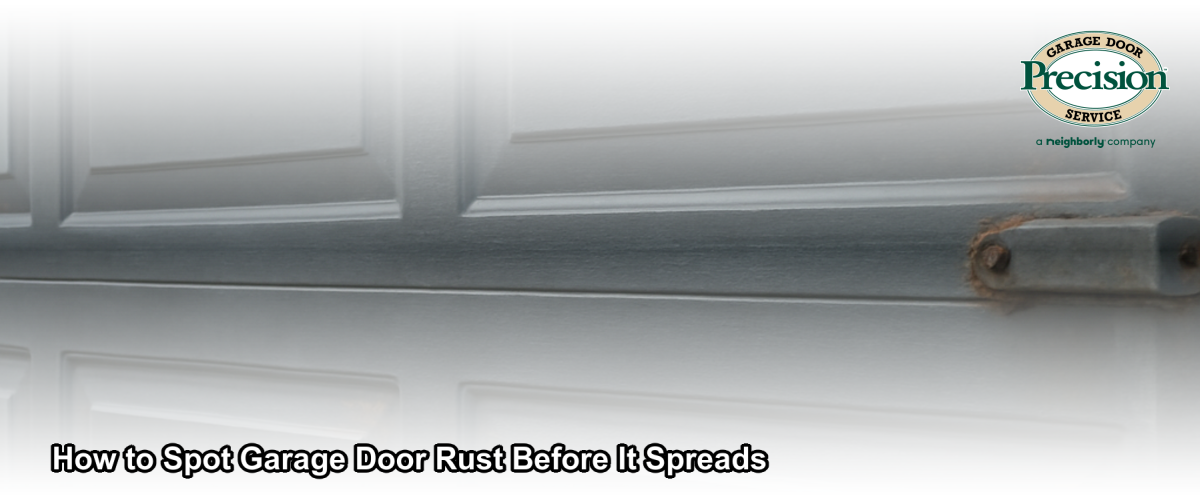
Chicago’s climate creates near-perfect conditions for garage door corrosion: freezing winters, road salt tracked in from driveways, heavy spring rainfall, and high summer humidity all attack metal surfaces simultaneously. Steel garage doors in Chicago face a longer, more aggressive corrosion season than doors in drier inland markets, meaning what starts as a pinhead-sized rust spot can spread to a full panel within a single winter if left untreated.
The combination of de-icing salt and freeze-thaw cycles is especially destructive. Salt lowers the freezing point of water, which keeps moisture active on metal surfaces even at temperatures where you’d expect it to be locked up as ice. That brine seeps into paint micro-cracks and begins oxidizing the steel underneath long before you can see it from the driveway.
What are the earliest visible signs of rust on a garage door?
The earliest signs of garage door rust are small orange or brown surface stains, bubbling or flaking paint, and white chalky deposits along seams — all of which appear before any structural damage has occurred and are still fully reversible with prompt action.
Here is what to look for during a close-up inspection, working from top to bottom:
- Paint bubbling or blistering — Moisture trapped beneath the paint film is lifting the coating off the metal. This is often the very first visible warning sign, even before color changes appear.
- Orange or reddish-brown streaking — Surface iron oxide forming on panels, most common at the bottom section where road salt and meltwater collect.
- White or chalky mineral deposits — Efflorescence along panel seams or around hardware holes signals water is repeatedly entering and evaporating in the same spot.
- Pitting on hardware — Small craters on hinges, rollers, and track brackets indicate galvanic corrosion, which progresses faster than surface rust on panels.
- Soft or spongy spots — Press gently on a suspect area. If the panel flexes more than surrounding steel, corrosion has eaten through the material thickness from the inside.
If you are not sure what you are looking at, our full seasonal maintenance guide covers the complete top-to-bottom inspection checklist in detail — it is a useful companion read alongside this post.
Which parts of a garage door are most vulnerable to corrosion?
The bottom panel, bottom seal bracket, hinges, and the area around pre-drilled hardware holes are the most corrosion-vulnerable parts of a garage door because they hold standing water, contact road salt directly, and have existing breaches in the paint or galvanizing layer.
The bottom panel takes the most abuse by far. Every time the door closes, it contacts the ground, picking up salt-laden moisture and compressing it against the steel edge. Over time, the factory paint chips along that edge and rust begins from the inside out — meaning the exterior surface looks fine right up until the panel is already compromised structurally.
Hinges and roller brackets are the second major concern. These components are made from lighter-gauge steel than the door panels, and the fastener holes are points where protective coatings are absent. IDA Certified Technicians at Precision Garage Door Chicago routinely find significant hinge corrosion on doors whose panels still look cosmetically clean, which is why hardware inspection should never be skipped during a maintenance visit.
Torsion springs sit above the door and are protected from direct water contact, but they are not immune — particularly in Chicago’s humid summers. Corroded springs are a safety concern separate from cosmetic rust and are covered in our guide to garage door spring inspection and replacement.
How do I tell the difference between surface rust I can fix myself and damage that needs a professional?
Surface rust that has not penetrated through the steel and has not spread to hardware or structural components is a legitimate DIY repair; rust that has caused through-holes, panel deformation, or hardware pitting deep enough to affect movement requires professional assessment before repairs mask the underlying damage.
A simple scratch test helps you gauge depth: use a coin or a key to scrape a rust spot lightly. If the rust lifts completely and clean, bright metal is visible underneath, it is true surface oxidation — treatable with rust-converter primer and touch-up paint. If the scraping reveals a dark, porous cavity or the metal bends or crumbles at the edges, the steel has lost structural integrity and the panel likely needs replacement rather than cosmetic repair.
Hardware pitting is harder to self-assess. A hinge that looks merely discolored may have lost 30 to 50 percent of its material thickness to corrosion — still functioning, but at elevated risk of sudden failure under load. When in doubt, an inspection by an IDA Certified Technician at Precision Garage Door Chicago will give you a documented condition report rather than a guess.
What is a practical step-by-step process for catching rust early at home?
A seasonal inspection done twice per year — once in late October before Chicago’s salt season begins, and once in April after the last freeze — is the most effective schedule for catching garage door rust before it advances beyond surface treatment.
Follow this sequence each inspection:
- Step 1 — Wash the door. Use a garden hose and mild detergent to rinse away salt deposits and road grime. Inspect only after the surface is clean and dry; salt residue disguises early rust staining.
- Step 2 — Inspect the bottom panel and seal bracket. Look for paint chipping, rust streaks, and any gaps where the seal contacts the door frame. Replace a cracked or brittle bottom seal immediately — it is the single cheapest way to keep water out.
- Step 3 — Check all hinges and roller brackets. Look for reddish-brown surface staining, pitting, and any fasteners that have seized or stripped. Lubricate clean hardware with a silicone-based spray; do not lubricate corroded hardware before assessing whether it needs replacement.
- Step 4 — Examine panel seams and joints. Run your fingers along horizontal seams between panels. Any roughness, separation of the seam edge, or chalky residue indicates water is infiltrating between panels.
- Step 5 — Check around any pre-drilled holes. Windows, lock cylinders, and decorative hardware mounting holes are paint-free entry points for moisture. Look for rust haloing outward from each hole.
- Step 6 — Inspect from the inside. Open the door fully and inspect the interior panel faces, particularly at the bottom. Interior rust almost always reflects a more advanced condition than the exterior surface reveals.
What does it cost to repair vs. replace a rusted garage door panel in Chicago?
Surface rust treatment and repainting on a single garage door panel in Chicago typically runs $75 to $200 as a DIY project in materials; professional panel replacement, when corrosion has progressed past the cosmetic stage, ranges from $250 to $800 or more per panel depending on door style, gauge, and finish.
Full door replacement becomes cost-competitive with multi-panel repair once two or more panels require replacement, especially on older doors where matching panels may no longer be available from the original manufacturer. A new single-car steel door starts around $700 to $1,200 installed in the Chicago market; a double-car door typically falls in the $1,100 to $2,500 range installed, varying by insulation rating and finish.
What hidden costs should Chicago homeowners anticipate?
When rust has spread to hardware, the cost of a panel alone understates the full repair bill — corroded hinges, rollers, and bottom brackets will typically need replacement at the same service call, adding $50 to $150 in parts per door depending on component count. If a rusted bottom seal has allowed persistent moisture intrusion, the wood subframe or concrete threshold may also need remediation, which falls outside garage door scope and should be budgeted separately.
Catching corrosion at the surface-treatment stage is always the lowest-cost outcome. The difference between a $100 DIY rust repair and a $600 panel replacement is often nothing more than one missed seasonal inspection.
Can I prevent garage door rust entirely, or just slow it down?
You cannot fully eliminate the risk of garage door corrosion in a Chicago climate, but consistent protective maintenance — annual washing, touch-up painting of any paint chips within the same season they appear, and silicone-based hardware lubrication — can extend the serviceable life of a steel door by a decade or more beyond an unmaintained door.
Galvanized steel and aluminum doors are inherently more corrosion-resistant than standard painted steel and are worth considering when it is time for a full replacement, particularly for homes closer to Lake Michigan where off-lake moisture is a compounding factor. Fiberglass doors eliminate the rust risk entirely but carry their own maintenance considerations discussed in our door materials comparison guide.
For existing steel doors, a clear automotive-grade wax applied over the painted surface once per year provides a meaningful additional moisture barrier at minimal cost. Apply it to clean, dry panels the same way you would wax a car hood — it is one of the most underused maintenance steps for steel garage doors.
This guide was prepared by IDA Certified Technicians at Precision Garage Door Chicago, serving Chicago, IL and the surrounding communities.
Frequently Asked Questions
How often should I inspect my garage door for rust in Chicago?
Inspect twice a year — once in late October before road salt season begins and again in April after the last freeze. Chicago’s salt-heavy winters accelerate corrosion significantly, so a spring inspection frequently reveals damage that was not visible the previous fall.
What is the first sign of rust on a garage door?
Paint bubbling or blistering is usually the first visible sign, appearing before any color change occurs. It means moisture has worked under the paint film and is beginning to oxidize the steel beneath — still fully reversible at this stage with rust-converter primer and touch-up paint.
Is a little rust on my garage door actually a problem?
Small surface rust spots are cosmetically fixable but should never be ignored in Chicago’s climate — they spread quickly once the paint barrier is broken. Left untreated through one winter of road salt and freeze-thaw cycles, a minor spot can grow into panel or hardware damage that costs hundreds of dollars to repair.
How much does it cost to repair a rusted garage door panel in Chicago?
Surface rust treatment is a DIY repair costing roughly $75 to $200 in materials. If corrosion has progressed to where a panel needs replacement, expect $250 to $800 or more per panel professionally installed, depending on door style and finish. Replacing two or more panels often makes full door replacement the more cost-effective option.
Can an IDA Certified Technician tell me if my rusted garage door is still safe to operate?
Yes. An IDA Certified Technician can assess structural integrity, hardware condition, and spring safety in a single inspection visit — providing a documented condition report rather than a visual guess. Precision Garage Door Chicago uses IDA Certified Technicians on all service calls in the Chicago area.