What do I need before programming a new garage door remote?
Before you program a new garage door remote, you need three things: the new remote itself, physical access to your garage door opener motor unit (the box mounted to your ceiling), and confirmation that your opener is not more than 30 years old — units that old may predate modern rolling-code technology and require a different approach entirely.
Check your opener’s brand and model number, printed on a label on the motor unit. Common brands in Chicago-area homes include LiftMaster, Chamberlain, Genie, Linear, and Craftsman. The programming method differs slightly by brand, so having that model number in hand before you start saves real time.
You will also need a step ladder tall enough to comfortably reach the motor unit — most are mounted 7 to 10 feet off the ground. If your opener uses a battery-powered remote, confirm the battery is fresh; a weak battery is the number-one reason a correctly programmed remote still fails to work consistently.
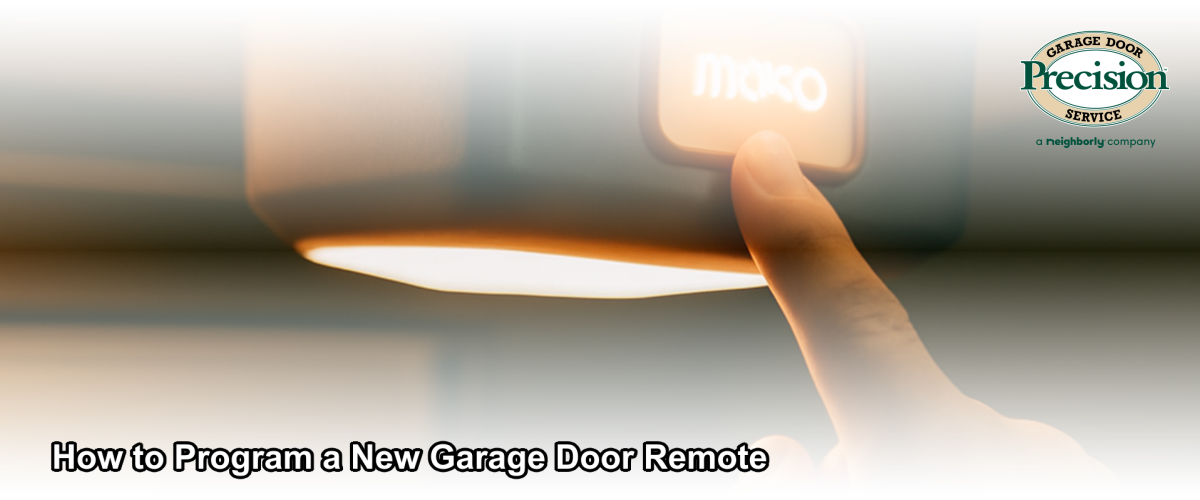
How do I program a garage door remote using the Learn button?
Programming a garage door remote using the Learn button takes fewer than 30 seconds and works on the vast majority of openers manufactured after 1993, including LiftMaster, Chamberlain, Genie, and Craftsman units found throughout Chicago and the surrounding suburbs.
Follow these steps:
- Locate the Learn button on your motor unit — it is typically a small, colored square button (yellow, green, purple, or orange depending on brand) near the antenna wire.
- Press and release the Learn button. An indicator light will turn on and stay on for 30 seconds.
- Within those 30 seconds, press and hold the button on your new remote that you want to use to open the door. Hold until the opener’s light flashes or you hear two clicks — this confirms the signal has been stored.
- Test immediately by pressing the remote from inside the garage. The door should move. Then test from the end of your driveway to confirm range.
If you have more than one remote to program, repeat the process for each one without pressing the Learn button again in between — most openers store up to 40 remote codes simultaneously.
How do I program a garage door remote on an older opener without a Learn button?
Openers manufactured before approximately 1993 use fixed DIP switches — a row of 8 to 12 tiny toggle switches inside both the motor unit and the remote — and must be programmed by physically matching those switch positions rather than using a Learn button.
Open the remote’s battery compartment (or a separate access panel) to expose the DIP switches. Then access the same switch bank on the motor unit itself, usually behind a small panel. Set every switch on the remote to match the exact pattern on the opener unit — all up, all down, or a specific combination. Once they match, the remote should operate the door immediately with no additional pairing step needed.
DIP-switch openers do not use rolling codes, which means the signal is less secure than modern systems. If security is a concern, this is a practical reason to consider upgrading your opener — as covered in our guide to choosing a new garage door opener. Precision Garage Door Chicago can advise on compatible modern replacements.
How do I program a garage door keypad to my opener?
Programming a wireless keypad to your garage door opener uses the same Learn button method as a handheld remote, with one additional step: after the opener’s Learn button light activates, you enter your chosen PIN on the keypad and then press the Enter or Send key (rather than holding a single remote button).
Choose a PIN that is 4 to 6 digits and not an obvious sequence like 1234 or your address number — the keypad is mounted outside your garage, visible to anyone walking past. Once programmed, test the PIN from the closed position and confirm the door reverses safely when the path is obstructed.
If your keypad has a backlit display and is not responding at all, replace the battery first — most wireless keypads use a standard 9-volt battery and the low-battery indicator is easy to miss in daylight.
Why won’t my new garage door remote work after programming?
The most common reasons a newly programmed garage door remote fails to work are a dead or weak remote battery, programming that was not completed within the 30-second Learn button window, or an opener that reached its maximum stored codes and needs to be cleared before it can accept a new one.
Work through this quick checklist before calling for service:
- Battery: Replace with a fresh battery even if the remote was new in the package — batteries degrade on shelves.
- Distance during programming: Stand within 5 feet of the motor unit when pressing the remote button. Interference from metal garage doors can reduce signal range during the pairing step.
- Code bank full: Press and hold the Learn button for 6 seconds until the indicator light goes out — this erases all stored remotes. Reprogram all devices from scratch.
- Frequency mismatch: Confirm the remote is compatible with your opener’s frequency. Most North American openers operate at 315 MHz or 390 MHz; a universal remote set to the wrong frequency will not pair.
- Antenna wire: Check that the thin wire hanging from the motor unit is fully extended and not coiled or tucked — a coiled antenna cuts range dramatically.
If none of these resolve the issue, the logic board on the motor unit may have failed, or the opener itself may be at the end of its service life. Precision Garage Door Chicago’s IDA Certified Technicians can diagnose a non-responsive opener during a same-day service visit across the Chicago metro area.
Can I program a HomeLink car visor button to my garage door opener?
Yes — HomeLink, the built-in garage door button found in most vehicles produced after 2000, can be programmed to your opener and replaces the need to carry a separate handheld remote entirely.
The process has two stages. First, you train HomeLink to copy your existing remote’s signal by holding both the remote and the HomeLink button simultaneously until the HomeLink indicator light changes from a slow blink to a rapid blink — typically 20 to 30 seconds. Second, for rolling-code openers (most openers made after 1996), you then press your opener’s Learn button and immediately press the HomeLink button one final time to complete the handshake.
Vehicles manufactured before 2005 may use an older HomeLink system that is not compatible with rolling-code technology. If your car is from that era and the standard method is not working, consult your vehicle owner’s manual for a model-specific workaround — or contact Precision Garage Door Chicago for guidance on compatible bridge devices.
What does it cost to have a professional program or replace a garage door remote in Chicago?
Having a professional reprogram an existing remote or set up a new one during a scheduled service visit is typically a minor add-on — the larger cost driver is the service call itself rather than the programming step, since programming takes only a few minutes once a technician is on-site.
If a remote needs to be replaced rather than just reprogrammed, expect to pay for the replacement remote in addition to the service call. Brand-specific remotes from the opener manufacturer tend to cost more than universal remotes, but they are generally more reliable and fully compatible with advanced features like battery-status alerts. Precision Garage Door Chicago stocks a range of compatible remotes for the most common opener brands found across Chicago neighborhoods.
For context on full opener replacement pricing — relevant when an older unit can no longer accept new remotes reliably — see our guide to garage door opener installation costs in Chicago.
Hidden costs and what is included when a technician handles remote programming
When Precision Garage Door Chicago sends an IDA Certified Technician to assist with remote programming, the visit typically also includes a visual safety inspection of the opener’s force settings and auto-reverse function — both required to meet current residential garage door safety standards. This is not an upsell; it is standard practice because a technician already has eyes on the unit.
What to expect during a professional programming visit:
- Verification that the opener’s logic board is functioning correctly and will hold new codes
- Programming of all remotes and keypads the homeowner provides
- HomeLink setup for vehicles in the driveway if requested
- Antenna and wiring inspection to confirm signal range is not being degraded
- A quick test of safety-reverse sensitivity — the door should reverse within 2 inches of contact with an obstruction
If the technician discovers that the logic board cannot store new codes, or that the opener’s safety functions are outside spec, you will receive a clear written explanation and a repair estimate before any additional work is performed. Precision Garage Door Chicago operates across the full Chicago metro area, including the North Shore, South Side, and western suburbs.
This guide was prepared by Precision Garage Door Chicago’s IDA Certified Technicians, serving Chicago, IL and the greater Chicago metro area.
Frequently Asked Questions
How long does it take to program a garage door remote?
Programming a new remote to a modern opener using the Learn button takes under 30 seconds once you are at the motor unit. Allow a few extra minutes to locate the Learn button, retrieve a step ladder, and test the remote from the driveway afterward.
Will programming a new remote erase my other remotes?
No — pressing the Learn button and pairing a new remote adds it to the opener’s memory without erasing existing ones. Most openers store up to 40 remote codes. You only lose stored remotes if you hold the Learn button for 6 or more seconds, which performs a full memory reset.
What if my garage door opener does not have a Learn button?
Openers without a Learn button use DIP switches — a row of small toggle switches inside both the remote and the motor unit. Set all switches on the remote to match the pattern on the opener, and the remote will work immediately. These are typically found on openers made before 1993.
Can I program any remote to my garage door opener?
Not every remote is compatible with every opener. You need a remote that matches your opener’s radio frequency (most commonly 315 MHz or 390 MHz) and rolling-code protocol. Universal remotes work with many brands but must be set to the correct frequency. Brand-specific remotes are the most reliable option.
When should I call a professional instead of programming the remote myself?
Call a professional if the remote still does not work after you have replaced the battery, cleared the opener’s memory, and re-paired within the 30-second window — this pattern usually indicates a failing logic board or antenna issue rather than a programming error. Precision Garage Door Chicago’s IDA Certified Technicians serve the full Chicago metro area and can diagnose the problem during a service visit.