
What do garage door hinges actually do, and why does their lifespan matter?
Garage door hinges are the metal brackets that connect each horizontal panel of your door, allowing it to flex and bend as it travels along the track from closed to open. Without functioning hinges, the panels cannot articulate — meaning a single failed hinge can stop your entire door in its tracks or cause a panel to buckle under tension.
Most residential garage doors have between 10 and 15 hinges depending on the number of panels and the door’s weight. On a standard two-car garage door in Chicago, IL, that hardware works through thousands of open-and-close cycles every year. The difference between hinges that last 5 years and hinges that last 15 or more years often comes down to three things: lubrication consistency, early detection of wear, and matching the hinge gauge to the door’s weight.
If you maintain your springs and cables but neglect the hinges, you are leaving one of the most active mechanical components in your system unprotected. See our full guide to annual garage door maintenance for a complete seasonal checklist that covers the whole system.
How often should I lubricate garage door hinges in Chicago’s climate?
In Chicago, IL, garage door hinges should be lubricated at least twice a year — once before winter sets in (typically October) and once in early spring after the thaw — because the city’s freeze-thaw cycles accelerate metal fatigue and dry out lubricant faster than in moderate climates.
Chicago winters regularly push temperatures below 0°F, which causes metal to contract and standard grease to stiffen. When a stiff hinge is forced to flex under load, the pin and knuckle wear unevenly, shortening the hinge’s usable life significantly. A mid-summer check is worthwhile too, since high humidity can introduce surface rust that acts like sandpaper on hinge pins.
When lubricating, apply a lithium-based spray grease or a dedicated garage door lubricant directly to the hinge pin and the inside of the knuckle — not the flat face of the bracket. Wipe away any excess immediately. Avoid WD-40 as a primary lubricant; it is a solvent and will displace existing grease without providing lasting film protection.
What is the correct way to lubricate garage door hinges without making a mess?
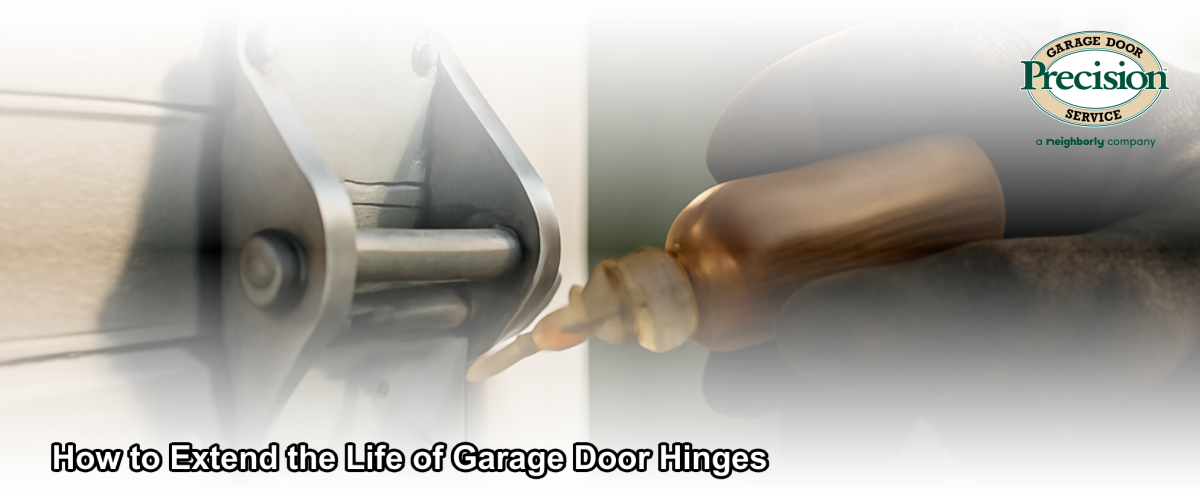
The correct method is to apply lubricant with a narrow-tip applicator directly to the hinge pin while the door is in the closed position, then slowly open and close the door two or three times to work the product into the joint before wiping the surrounding panel surface clean.
Here is a step-by-step process that IDA Certified Technicians at Precision Garage Door Chicago use during routine maintenance visits:
- Close the door fully and disconnect the opener so the door cannot move automatically during inspection.
- Apply a small amount of lithium-based grease or dedicated garage door lubricant to each hinge pin and knuckle — one to two seconds of spray per hinge is sufficient.
- Reconnect the opener and run the door through two to three full cycles to distribute the lubricant evenly.
- Wipe down any overspray on the door panels and floor immediately, since lubricant attracts dust and debris.
Avoid lubricating the hinge faces, the track, or the rollers at the same time without knowing which products are compatible — cross-contamination can attract grit that accelerates wear rather than preventing it.
How do I know when a garage door hinge needs to be replaced rather than lubricated?
A garage door hinge needs replacement — not just lubrication — when you see visible cracking, elongated pin holes, bent or warped bracket flanges, or when the hinge moves audibly even after fresh lubrication has been applied.
Watch for these specific warning signs during your next visual inspection:
- Oblong pin holes: The hole where the pin sits should be circular. If it has stretched into an oval, the hinge has been carrying load beyond its rated capacity and will fail progressively faster.
- Cracks along the knuckle or bracket: Any visible cracking in the metal is an immediate replacement indicator — cracks propagate under cyclical load.
- Squealing or grinding after lubrication: If noise persists within 24 to 48 hours of proper lubrication, the metal-on-metal wear is already severe enough that lubricant cannot compensate.
- Rust penetrating the joint: Surface rust on the face of a hinge is cosmetic; rust inside the knuckle or around the pin is structural and means the hinge should be replaced.
On a typical Chicago home, hinge wear also accelerates near the bottom sections of the door, where weather seal friction and panel weight concentrate stress. Those lower hinges are worth inspecting first.
Does hinge gauge (thickness) matter, and how do I choose the right one?
Yes — hinge gauge matters significantly, and installing an under-gauge hinge on a heavy door is one of the fastest ways to shorten hinge lifespan. Residential garage door hinges are rated by number: a #1 hinge is the lightest gauge, while a #3 hinge is heavier and used on commercial-grade or oversized residential doors.
Standard single-car doors with steel panels typically use #1 and #2 hinges. Heavier double-car doors — especially insulated models common in Chicago’s older bungalow neighborhoods where garages are often detached and exposed to full winter wind loads — frequently require #2 and #3 hinges on the lower panels where stress is highest. Using a lighter gauge than the door requires causes the pin holes to elongate rapidly, producing the oval-hole failure pattern described above.
If you are unsure of the correct gauge for your door, an IDA Certified Technician can assess the door weight, panel count, and current hinge condition and specify the right replacement hardware. Precision Garage Door Chicago stocks a full range of residential hinge grades for same-visit installation.
What hidden costs or extras should I expect when having hinges serviced professionally?
When a technician visits specifically for hinge maintenance or replacement, the service call typically covers inspection of the entire door system — not just the hinges — which can surface additional needs you will want to budget for.
Here is what is commonly included or flagged during a professional hinge service visit:
- Full hinge lubrication pass: All hinges on the door, not just the ones that were audibly failing.
- Roller inspection: Rollers share the same mounting holes as hinges and often wear at the same rate — a technician will note if nylon or steel rollers are due for replacement.
- Bracket tightening: Hinge-mounting bolts loosen over time, especially in Chicago where thermal cycling causes the wood or steel frame to expand and contract. Re-torquing loose bolts is usually included in a maintenance visit.
- Panel condition note: If a hinge has been failing for a while, the panel it is mounted to may have stress cracks or deformation at the hinge points — this would be noted as a separate repair.
Replacement hinges themselves are a modest hardware cost, but labor and the comprehensive inspection are where the value of a professional visit is concentrated. Addressing multiple worn components in a single visit is almost always more cost-effective than booking separate service calls, and Precision Garage Door Chicago’s IDA Certified Technicians carry common replacement hardware on the truck for same-day resolution.
Can I extend hinge life by adjusting how I use my garage door?
Yes — usage habits have a measurable effect on hinge wear, and the simplest change is to avoid stopping the door mid-travel repeatedly, which places asymmetric load on whichever hinges are under tension at the point of interruption.
Other operational habits that extend hinge life include:
- Keeping the door balanced — an unbalanced door forces hinges to compensate for uneven panel alignment on every cycle. Our guide to garage door spring balance explains how to check this in under two minutes.
- Not forcing a door that hesitates — if the opener strains or the door pauses, stopping and investigating is safer than repeatedly cycling through the resistance, which spikes hinge stress.
- Keeping the garage floor clear of debris near the door base — gravel and grit kicked up by the door’s movement can embed in hinge joints and act as an abrasive.
In Chicago’s climate, parking a salt-covered vehicle directly under an open door in winter also accelerates rust formation on lower hinges. A simple floor mat and a moment to close the door before washing off road salt significantly reduces the corrosive exposure those hinges experience.
This guide was prepared by IDA Certified Technicians at Precision Garage Door Chicago, serving Chicago, IL and the surrounding region.
Frequently Asked Questions
How often should I lubricate garage door hinges?
Lubricate garage door hinges at least twice a year — once in fall before freezing temperatures arrive and once in early spring. In Chicago’s climate, the freeze-thaw cycle dries out lubricant faster than in milder regions, so a mid-summer check is also worthwhile.
What is the best lubricant for garage door hinges?
A lithium-based spray grease or a dedicated garage door lubricant applied directly to the hinge pin and knuckle is best. Avoid WD-40 as a primary lubricant — it is a solvent that displaces grease rather than providing lasting protection.
How do I know if my garage door hinges need to be replaced?
Replace hinges if you see oval-shaped pin holes, cracks in the bracket or knuckle, rust inside the joint, or if squealing or grinding persists more than 24 to 48 hours after proper lubrication. Surface wear beyond that point cannot be reversed with maintenance alone.
Does hinge gauge matter for a residential garage door?
Yes. Heavier doors require higher-gauge hinges — a #1 hinge suits lighter single-car doors, while insulated or oversized double-car doors often need #2 or #3 hinges on the lower panels. Using an under-gauge hinge causes the pin holes to elongate quickly, leading to premature failure.
Can I replace garage door hinges myself, or do I need a professional?
Lubricating hinges is a straightforward DIY task. Replacing a hinge is manageable if the door is balanced and the panel is undamaged, but if lower hinges near the spring system are involved, or if panels show stress damage, an IDA Certified Technician should assess the repair to avoid releasing spring tension unsafely.