

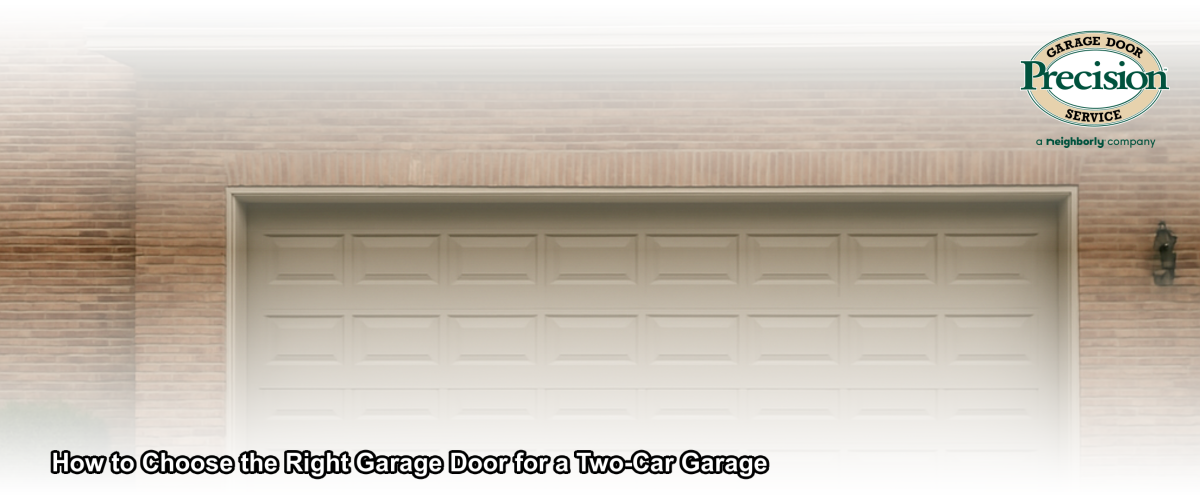
What size garage door do you need for a two-car garage?
Most two-car garages use a single wide door that measures either 16 feet or 18 feet wide, with a standard height of 7 or 8 feet. A 16-foot door comfortably fits two standard vehicles side by side, while an 18-foot door gives extra clearance for larger trucks, SUVs, or tighter driveways. Some homeowners choose two separate 9-foot single doors instead — a layout that can be easier to operate independently and may better suit narrower garage openings.
Before ordering, measure your rough opening carefully: width, height, and the amount of headroom above the opening (typically at least 10 to 12 inches for a standard torsion spring system). Precision Garage Door Chicago recommends a professional site measurement before any door is ordered, since Chicago-area homes — especially older bungalows and two-flats — frequently have non-standard openings that need custom sizing.
What garage door materials hold up best in Chicago winters?
Steel is the most popular and practical material for Chicago homeowners because it handles freeze-thaw cycles, road salt air, and heavy snow loads better than wood or aluminum. Chicago temperatures routinely swing from below 0°F in January to above 90°F in July, which causes untreated wood doors to warp, swell, and crack over time. Steel doors with a polyurethane or polystyrene foam core resist that thermal stress while adding meaningful insulation value.
Here is a quick comparison of the most common materials:
- Steel: Durable, low-maintenance, available in insulated and non-insulated versions, takes paint well, most affordable option
- Wood composite (faux wood): The look of real wood without the warping risk — a strong fit for Chicago’s climate swings
- Real wood: Beautiful but requires annual refinishing; best suited to climate-controlled garages or historically matched homes
- Aluminum: Lightweight and rust-resistant, but dents easily and provides minimal insulation — less ideal for exposed Chicago garages
- Fiberglass: Resistant to salt and moisture but can become brittle in sustained sub-zero temperatures
IDA Certified Technicians at Precision Garage Door Chicago consistently steer two-car garage customers toward insulated steel or wood-composite doors as the best long-term value for this climate.
How much does a two-car garage door cost in Chicago?
A new two-car garage door in Chicago typically ranges from $800 to $3,500+ for the door itself, with professional installation adding roughly $200 to $600 depending on the complexity of the job. Mid-range insulated steel doors — the most commonly purchased category — generally land between $1,200 and $2,200 installed. Custom wood or carriage-house style doors can push the total well above $4,000.
Several factors move that number up or down:
- Door width and height: An 18-foot door costs more than a 16-foot door in both material and hardware
- Insulation rating (R-value): Higher R-value panels cost more upfront but reduce heating costs in an attached garage
- Panel style and finish: Flush panels are the most affordable; raised-panel and carriage-house designs carry a premium
- Opener compatibility: If your existing opener is outdated or undersized for a heavier door, factor in opener replacement
- Spring and hardware upgrade: A wider, heavier door typically requires a heavier-duty torsion spring system
See our full guide to garage door replacement costs for a deeper breakdown of what drives the final number on any job.
What R-value insulation do you need for a Chicago two-car garage?
For an attached two-car garage in Chicago, an insulated door with a minimum R-value of R-12 is a practical baseline, and R-16 or higher is worth the upgrade if the garage is heated or shares a wall with living space. Chicago’s heating season runs roughly from October through April, meaning an uninsulated door is losing conditioned air for more than half the year.
Polyurethane-injected foam cores achieve higher R-values (typically R-13 to R-18) than polystyrene batt inserts (typically R-6 to R-10) because the foam fills the panel cavity completely with no air gaps. For detached garages used only for vehicle storage, a lower R-value is acceptable — but any garage with a workshop, utility equipment, or an EV charger benefits significantly from better thermal performance.
What style of garage door works best for Chicago homes?
The right style depends on your home’s architecture — and Chicago’s housing stock is unusually varied, from 1920s brick bungalows in Beverly and Bridgeport to contemporary new builds in the West Loop and Fulton Market. Raised-panel steel doors are the default choice for traditional and colonial-style homes. Carriage-house doors with decorative hardware suit craftsman bungalows and vintage two-flats. Flush, full-view aluminum or glass-panel doors fit modern and contemporary architecture well.
Beyond aesthetics, consider how the door style handles Chicago wind loads. Wide 16- to 18-foot doors act like sails in high-wind events — a common concern near the lakefront. Ask your installer about wind-rated door options and horizontal bracing struts, which Precision Garage Door Chicago’s IDA Certified Technicians can specify based on your home’s exact exposure.
Should you choose one wide door or two single doors for a two-car garage?
One wide door is simpler mechanically, requires only one opener, and typically costs less to install than two separate doors with two openers. Two single doors give each driver independent access, can simplify replacement if only one door is damaged, and can be easier to insulate around the center post. There is no universal right answer — it comes down to your driveway layout, how often two vehicles need to enter or exit simultaneously, and your budget.
One practical note for Chicago homeowners: two separate doors mean two separate bottom seals and two sets of weather stripping, which can actually provide a tighter overall seal at ground level than a single wide door. In a climate where wind-driven snow piles against garage doors, that detail matters.
What hidden costs should you expect when replacing a two-car garage door in Chicago?
Beyond the door and basic installation, several line items catch homeowners off guard. Knowing them ahead of time turns an estimate into an accurate budget.
- Haul-away of the old door: Some installers include disposal; others charge $50 to $150 separately — always confirm
- Spring replacement: Torsion springs on a heavier two-car door wear faster; if the existing springs are more than 7 to 10 years old, replacing them at the same time as the door avoids a second service call fee later
- Track and hardware upgrade: Older tracks may not be rated for a modern heavier door — mismatched hardware is a safety issue, not just a compatibility one
- Opener upgrade: A 1/2 HP opener adequate for a single door may struggle with a heavy insulated two-car door; 3/4 HP or 1 HP is more appropriate
- Permit fees: Chicago and surrounding Cook County municipalities may require a permit for structural garage work — your installer should advise on this
- Weather seal replacement: If the existing frame seal or threshold seal is deteriorated, budget an additional $50 to $100 for new seals
As covered in our guide to garage door maintenance, catching these issues during installation is always less expensive than addressing them after a failure.
How do you choose a trustworthy garage door installer in Chicago?
The most reliable signal of a qualified installer is industry certification — specifically, look for IDA (International Door Association) certified technicians, which indicates formal training in door mechanics, safety standards, and proper installation practices. Precision Garage Door Chicago employs IDA Certified Technicians and serves homeowners throughout the Chicago metro area, from the North Shore suburbs to the South Side and surrounding Cook County communities.
Beyond certification, ask any installer these three questions before committing: Does the estimate include haul-away? What warranty covers both the door and the labor? And who do you call if something goes wrong after installation? A reputable company answers all three without hesitation.
This guide was prepared by Precision Garage Door Chicago’s IDA Certified Technicians, serving Chicago, IL and the greater Chicago metro area.
Frequently Asked Questions
What is the standard size of a two-car garage door?
The most common two-car garage door size is 16 feet wide by 7 or 8 feet tall. An 18-foot wide door is also available for larger vehicles or wider openings. Some homeowners opt for two separate 9-foot single doors instead of one wide door.
How much does it cost to install a two-car garage door in Chicago?
A new two-car garage door installed in Chicago typically costs between $1,200 and $2,200 for a mid-range insulated steel door. Budget door-and-installation packages start around $800, while custom wood or carriage-house doors can exceed $4,000 total.
What R-value should a garage door have in Chicago?
For an attached garage in Chicago, a minimum R-value of R-12 is a practical baseline, with R-16 or higher recommended if the garage is heated or shares a wall with living space. Polyurethane foam-core doors typically achieve R-13 to R-18, which is higher than polystyrene-insulated doors.
Is steel or wood better for a Chicago garage door?
Steel is generally the better choice for Chicago’s climate. Wood doors can warp, swell, and crack under the city’s extreme temperature swings — from below 0°F in winter to above 90°F in summer. Insulated steel or wood-composite doors handle those conditions with far less maintenance.
Should I get one wide garage door or two single doors for a two-car garage?
One wide door is simpler and usually less expensive to install, requiring only one opener. Two single doors allow independent access and can provide a tighter weather seal at ground level — a real advantage in Chicago winters where wind-driven snow accumulates along the base of the door.