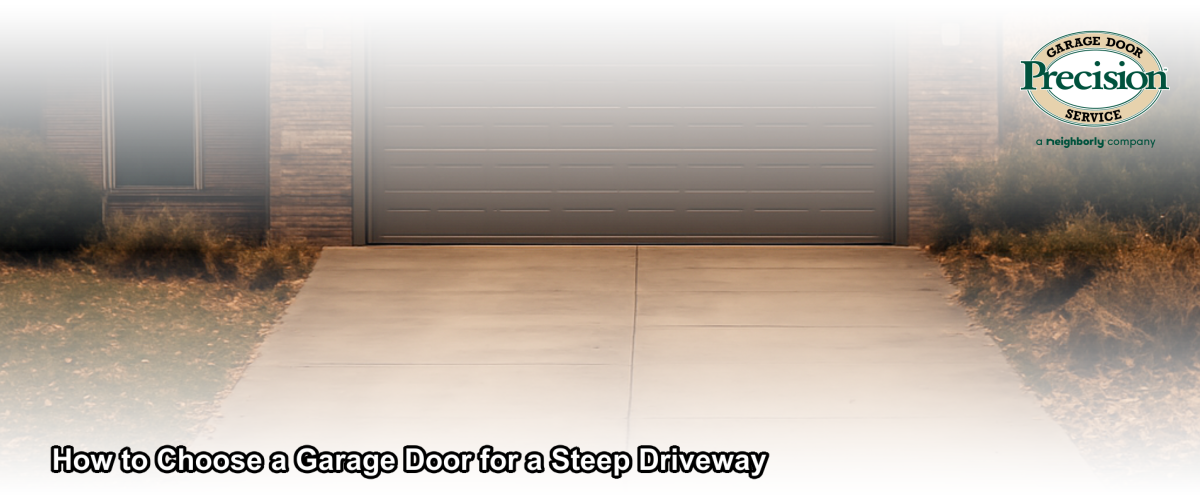
Does the slope of your driveway actually affect which garage door you can install?
Yes — the pitch of your driveway directly determines which door styles, spring systems, and openers will work safely at your home. A standard garage door setup is engineered for level or near-level approaches, and when the grade steepens beyond a few degrees, the mechanical loads shift in ways that can cause premature wear, opener strain, or even a door that won’t seal properly at the floor.
At Precision Garage Door Chicago, our IDA Certified Technicians assess driveway grade as a standard part of every installation consultation — it’s one of the most commonly overlooked factors when Chicago homeowners are shopping for a new door.
What garage door styles work best on a steep driveway?
Sectional overhead doors are almost always the right choice for steep driveways because they open vertically and don’t require any clearance in front of the garage opening — unlike swing-out or tilt-up canopy doors, which need flat foreground space to operate safely.
With a sectional door, the panels hinge upward along the track regardless of what’s happening at ground level. This means a driveway sloping sharply toward the garage doesn’t interfere with the door’s travel path. One-piece tilt-up doors, by contrast, swing outward and downward before rising — a movement that can clip a vehicle parked on a steep incline or bind against uneven pavement.
- Sectional overhead doors — best all-around choice for steep grades; panels track vertically without forward swing
- Roll-up doors — a viable alternative for utility garages; coil tightly above the opening with no outward movement
- Tilt-up / one-piece doors — not recommended for steep driveways; require flat clearance zone in front of the opening
- Side-hinged carriage doors — avoid on grades steeper than a few degrees; door weight pulls unevenly and sealing at the bottom is unreliable
How does a steep driveway affect garage door springs and hardware?
A steep driveway changes how weight and tension distribute across your spring system, and getting this wrong shortens spring life significantly. When a garage sits at the top of an incline, the door’s effective weight feels heavier to the opener and spring assembly because gravity is working against the lift direction at a steeper angle.
Torsion springs — mounted horizontally above the door opening on a metal shaft — handle these uneven loads better than extension springs, which run along the sides of the track. Torsion systems provide more controlled, balanced lift and are the configuration our IDA Certified Technicians at Precision Garage Door Chicago recommend for any installation involving a notable grade change.
High-cycle torsion springs rated for 50,000 cycles or more are worth the upgrade on steep-driveway homes, since the opener works harder on every cycle and standard springs fatigue faster under that added load. As covered in our full spring replacement guide, undersized or mismatched springs are one of the leading causes of premature opener failure.
What type of garage door opener handles a steep driveway best?
Belt-drive and direct-drive openers with a motor rated at 1/2 horsepower or higher are the most reliable choices when the door faces an incline, because they deliver smoother, more consistent torque than chain-drive units under variable load conditions.
Horsepower requirements increase when a driveway slopes toward the garage, so a motor that would be adequate for a flat approach may struggle or overheat on a steep one. For heavier doors — solid wood or full-view aluminum panels over 18 feet wide — step up to a 3/4 HP or 1 HP unit.
Smart openers with built-in obstacle detection and auto-reverse sensitivity adjustments are especially important on steep driveways. If a vehicle creeps forward on the grade while the door is in motion, a properly calibrated auto-reverse prevents damage. Our technicians set these sensitivity thresholds during every installation, not just at the default factory setting.
Will my garage door seal properly at the bottom if my driveway is sloped or uneven?
A steep or crowned driveway often creates gaps at the bottom of a closed garage door, which in Chicago’s winters means cold air infiltration, moisture intrusion, and the kind of ice dams that can freeze a door shut overnight. Proper sealing on a sloped approach requires more than a standard flat bottom seal.
The fix is typically a contoured or flexible bottom weatherstrip — sometimes called a T-style or J-style astragal — that conforms to slight surface irregularities rather than bridging over them. In cases where the driveway pitch is severe, a threshold seal bonded to the concrete creates a secondary barrier the door closes against. Precision Garage Door Chicago installs both configurations and can recommend the right combination based on your specific slab angle and surface condition.
Chicago’s freeze-thaw cycles compound this issue. Concrete near the garage apron heaves and settles seasonally, so a seal that fits perfectly in October may gap by February. Flexible vinyl seals handle this movement better than rigid rubber alternatives — see our weatherstripping maintenance guide for seasonal inspection tips.
Does a steep driveway affect garage door installation cost in Chicago?
Yes — installations involving steep driveways typically carry a modest premium over a standard flat-approach job, primarily because the spring system often needs to be upsized and the track configuration may require modification to match the entry angle.
Homeowners in Chicago should expect that a steep-driveway installation may involve:
- Upgraded torsion spring assembly (higher cycle rating, potentially dual-spring configuration)
- A higher-horsepower opener motor than a flat approach would require
- Custom or extended vertical track sections if the garage floor sits notably above the driveway grade
- Threshold seal or contoured bottom weatherstrip in addition to standard perimeter sealing
- A concrete apron inspection or minor leveling recommendation before installation proceeds
None of these are hidden costs — a thorough pre-installation assessment by an IDA Certified Technician will identify exactly what your driveway grade requires before any work begins. Getting the hardware right at installation is significantly less expensive than replacing a burnout opener motor or blown spring two years later.
What should I look for when choosing a garage door material for a Chicago home with a steep driveway?
Steel insulated doors in the 24- to 28-gauge range are the most practical material choice for steep-driveway homes in Chicago — they offer the best balance of weight, thermal performance, and long-term durability under the mechanical stress that a steep approach adds to every operating cycle.
Heavier materials like solid wood or composite wood look beautiful but add significant door weight, which compounds the spring and opener load issues already present on a slope. If the aesthetic of a wood or carriage-style door matters to you, steel doors with an embossed wood-grain finish deliver nearly identical curb appeal at roughly half the operational weight.
Insulation value matters especially in Chicago. A steel door with a polystyrene or polyurethane core rated R-12 to R-18 keeps the garage significantly warmer in January and reduces the expansion and contraction cycles that cause tracks and hardware to loosen over time — a problem that is more pronounced when hardware is already under the extra stress of a steep driveway.
When is the best time to schedule a garage door installation on a steep driveway in Chicago?
Late spring through early fall — roughly May through October — is the optimal window for garage door installations on steep driveways in Chicago, primarily because concrete apron conditions and weatherstrip seating are easier to assess and correct when temperatures are above freezing.
Installing in winter is entirely possible and Precision Garage Door Chicago performs installations year-round, but cold temperatures affect adhesive-backed seals and make concrete work (if any apron correction is needed) more complicated. If your old door fails mid-winter, don’t wait — a malfunctioning door on a steep icy driveway is a safety hazard — but if you’re planning a proactive upgrade, scheduling in the warmer months gives the installation team more options.
This guide was prepared by Precision Garage Door Chicago’s IDA Certified Technicians, serving Chicago, IL and the surrounding region.
Frequently Asked Questions
Can I install any garage door on a steep driveway?
Not all door styles are suitable for steep driveways. Sectional overhead doors are the best choice because they open vertically without swinging outward, which is essential when the driveway slopes sharply toward the garage. Tilt-up and side-hinged doors require flat clearance in front of the opening and are not recommended for steep grades.
What kind of springs do I need for a garage door on a steep driveway?
Torsion springs are strongly preferred over extension springs for steep-driveway installations because they handle uneven loads more reliably and provide balanced lift when the approach is angled. High-cycle torsion springs rated for 50,000 cycles or more are worth the upgrade since the opener and spring system work harder on every cycle compared to a flat approach.
Why does my garage door have a gap at the bottom on a sloped driveway?
A sloped or uneven driveway prevents a standard flat bottom seal from making full contact with the concrete, leaving gaps that allow cold air and moisture in. A contoured or flexible T-style bottom weatherstrip, or a threshold seal bonded to the slab, is the typical fix — especially important in Chicago where freeze-thaw cycles can widen seasonal gaps.
Does a steep driveway require a more powerful garage door opener?
Yes. A steep driveway increases the effective load on the opener motor, so a unit that would be adequate for a flat approach may overheat or wear out prematurely on a slope. A belt-drive or direct-drive opener rated at 1/2 HP or higher is recommended, with 3/4 HP or 1 HP for heavier or wider doors.
How do I know if my driveway grade will cause problems with a new garage door?
An on-site assessment by an IDA Certified Technician is the most reliable way to determine whether your driveway grade requires spring upgrades, track modifications, or enhanced sealing. Precision Garage Door Chicago includes this evaluation as part of every installation consultation so the right hardware is specified before work begins.