What is a garage door opener soft start and soft stop feature?
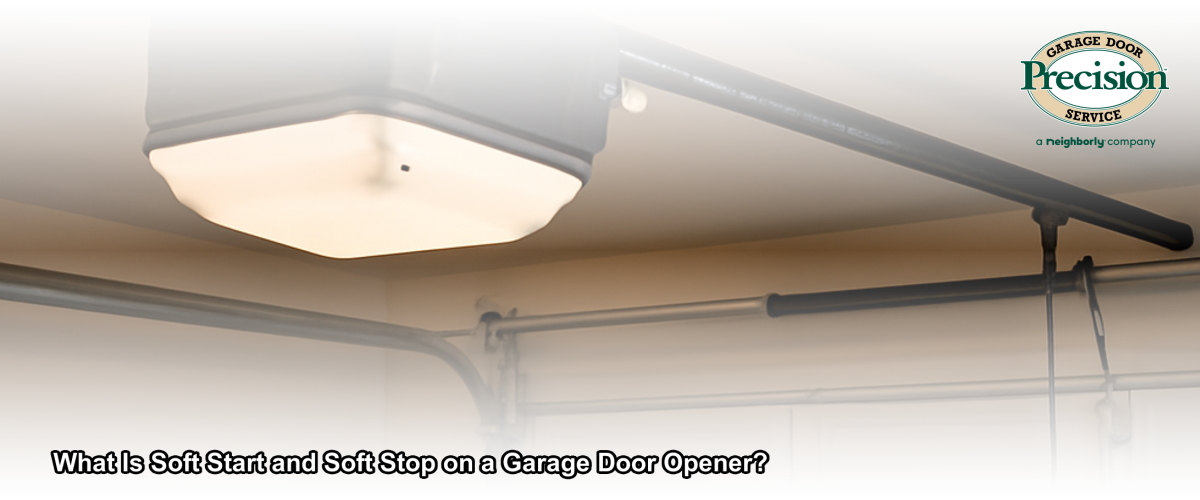
Soft start and soft stop is a motor control technology built into certain garage door openers that gradually ramps the motor up to full speed when opening and gently decelerates it to a complete stop when closing, rather than snapping the door into motion or slamming it to a halt at full torque. Think of it as cruise control for your garage door — smooth acceleration in, smooth braking out.
Without this feature, a standard opener fires at full power the instant you press the button, sending a jarring jolt through the door, the springs, the tracks, and every hardware connection in the system. Over time, that repeated mechanical shock adds up. With soft start and soft stop, the load is cushioned at both ends of every cycle.
At Precision Garage Door Chicago, our IDA Certified Technicians frequently recommend openers with this feature to homeowners who want to extend the life of their system and reduce the noise that travels into living spaces above or adjacent to the garage.
Why does soft start and soft stop matter for garage door longevity?
Every time a standard opener fires at full torque from a dead stop, it places sudden, concentrated stress on the weakest point in your system at that moment — whether that is a roller, a hinge, a spring coil, or the cable drum. Soft start eliminates that spike by distributing the load across the first fraction of a second of movement instead of concentrating it at the precise instant of departure.
The same principle applies at the close. A hard stop transfers kinetic energy back into the door panels, the bottom seal, and the floor contact — especially relevant in Chicago winters when cold-stiffened seals and frost on the threshold can make abrupt stops more punishing. Soft stop brings the door down gently, protecting panels, weatherstripping, and the opener’s internal drive components simultaneously.
The practical result: hardware wears more evenly, and the intervals between service calls tend to stretch out. As we cover in our maintenance guide, most garage door components fail at stress concentration points — and soft start and soft stop technology directly targets that failure mode.
Does soft start and soft stop make a garage door opener quieter?
Yes — soft start and soft stop measurably reduces the operational noise of a garage door opener, particularly the two loudest moments in any cycle: the initial lurch when the motor engages and the thud when the door seats at the bottom of its travel. Because the motor ramps up and ramps down rather than switching abruptly between zero and full speed, the mechanical vibration transmitted to the ceiling, the wall framing, and the door itself is significantly lower.
This matters most in Chicago homes where the garage is attached and shares a wall or ceiling with a bedroom, a home office, or a living room. Belt-drive openers with soft start and soft stop are among the quietest systems available and are the configuration our IDA Certified Technicians most commonly recommend for attached garages in the Chicago area where noise transfer is a real concern.
Which garage door openers have soft start and soft stop?
Soft start and soft stop is not universal — it is a feature found primarily in mid-range and premium opener models, typically in DC motor-driven units rather than older AC motor designs. DC motors are inherently better suited to variable-speed control, which is what makes gradual acceleration and deceleration mechanically possible in the first place.
When evaluating openers, look for this feature explicitly listed in the product specifications rather than assuming it is included. Common configurations that tend to include it:
- DC belt-drive openers rated for residential use
- DC chain-drive openers in the mid-to-premium tier
- Smart openers with integrated speed-control electronics
- Openers marketed specifically as ‘ultra-quiet’ or ‘soft-close’
If you are unsure whether a specific model includes true soft start and soft stop — as opposed to simple speed reduction — the team at Precision Garage Door Chicago can walk you through the options that make sense for your door size, spring configuration, and budget before any purchase is made.
Is soft start and soft stop worth the extra cost for Chicago homeowners?
For most Chicago homeowners with an attached garage, the answer is yes — and the value case is strongest for homes where the garage shares structure with living space, homes with heavier solid-wood or carriage-style doors, and any household where the garage is used multiple times per day. The incremental cost of a soft start opener over a basic model is generally offset by reduced hardware wear, fewer service calls, and the quality-of-life improvement of a dramatically quieter system.
Chicago’s climate adds another layer of relevance. Temperature swings between January lows and July highs cause door components — springs, cables, rollers, and weatherstripping — to expand, contract, and stiffen seasonally. A hard-starting opener stresses already-strained components during the coldest months when metal is least forgiving. Soft start reduces that cold-weather mechanical shock, which is one of the more underappreciated benefits in a four-season climate like Chicago’s.
What hidden costs or upgrade decisions come with choosing a soft start opener?
Choosing an opener with soft start and soft stop is straightforward, but a few adjacent decisions are worth understanding before installation so there are no surprises.
- Compatibility with existing hardware: A new opener paired with worn springs or damaged rollers will still experience accelerated wear regardless of soft start capability. An IDA Certified Technician at Precision Garage Door Chicago will inspect the full system before installation to flag any components that should be addressed at the same time.
- Drive type matters independently: Soft start is a motor control feature; the drive type (belt, chain, or screw) affects noise and maintenance separately. A soft start chain-drive opener is quieter than a hard-start chain-drive, but still louder than a soft start belt-drive. Do not conflate the two improvements — both matter.
- Smart home integration: Many openers with soft start also include Wi-Fi connectivity and app control. If that is a priority, confirm it is included in the specific model rather than assuming the feature bundle travels together.
- Installation labor: Opener replacement typically includes disconnecting and removing the old unit, mounting and adjusting the new one, and testing force limits and safety reversal. Ask your technician exactly what the installation scope covers.
How do I know if my current opener lacks soft start and soft stop?
The easiest test is direct observation: stand near your garage door and press the button to open it. If the door lurches abruptly into motion with a noticeable jolt or bang, and stops with a hard thud at both ends of travel, your opener almost certainly does not have soft start and soft stop. Openers with the feature feel noticeably smoother — the door eases into motion and glides to a stop rather than snapping between states.
Older openers — generally those installed before roughly 2010-2012 — are very unlikely to include this feature, as it became common in residential openers only as DC motor technology became standard at accessible price points. If your opener is 10 or more years old, a full evaluation by an IDA Certified Technician will tell you not just whether soft start is missing, but whether the unit is approaching the end of its useful service life overall.
Can Precision Garage Door Chicago upgrade my opener to add soft start and soft stop?
Soft start and soft stop is built into the motor control electronics of the opener unit itself — it cannot be added as an aftermarket accessory to an existing opener that does not have it. The upgrade path is a full opener replacement, which Precision Garage Door Chicago handles as a complete service including removal of the old unit, installation and alignment of the new opener, safety testing, and instruction on any new remote or app features.
If your current opener is otherwise functioning well and you are primarily interested in noise reduction, our IDA Certified Technicians can also assess whether lubrication, roller replacement, or spring adjustment would meaningfully reduce operational noise before recommending a full replacement. The goal is always to give you the right solution for your situation — not the most expensive one.
This guide was prepared by Precision Garage Door Chicago’s IDA Certified Technicians, serving Chicago, IL and the surrounding region.
Frequently Asked Questions
What does soft start and soft stop do on a garage door opener?
Soft start gradually ramps the opener motor to full speed when the door begins moving, and soft stop gently decelerates it before the door reaches the end of its travel. This eliminates abrupt jolts at the start and hard thuds at the stop, reducing stress on springs, rollers, and drive components.
Do all garage door openers have soft start and soft stop?
No — soft start and soft stop is found primarily in mid-range and premium DC motor openers. Older AC motor openers and budget models typically fire at full torque instantly and stop abruptly. Always verify the feature is listed in the product specifications before purchasing.
Does soft start and soft stop reduce garage door noise?
Yes. The two loudest moments in any opener cycle are the initial motor surge and the impact at the end of travel — soft start and soft stop cushion both, resulting in noticeably quieter operation that is especially valuable in attached garages with living space above or adjacent.
Can soft start be added to my existing garage door opener?
No — soft start is built into the motor control electronics of the opener unit and cannot be retrofitted. Adding this feature requires replacing the opener with a model that includes it from the factory.
Why is soft start especially useful for Chicago homeowners?
Chicago’s extreme seasonal temperature swings cause springs, cables, and rollers to stiffen in winter. A hard-starting opener forces maximum torque through already-stressed cold-weather components, accelerating wear. Soft start distributes that load gradually, which is a meaningful mechanical advantage in a four-season climate.